The global bath oil market is projected to reach USD 2.57 billion by 2025, growing at 8% annually. Discover why emulsifying bath oil is the next premium body care category — and how to launch your own private label line.
The Quiet Rise of Luxury Bath Oil
For years, the premium body care conversation centred on body lotions, serums, and scrubs. Bath oil — once associated with vintage apothecary aesthetics — is staging a sophisticated comeback, and the timing for private label brands has never been better.
According to MarketsandMarkets, the global bath oil market is projected to reach USD 2.57 billion by 2025, growing at approximately 8% annually from 2020. Grand View Research places the broader bath and shower products category at USD 17.9 billion by 2025, with private label brands capturing an increasingly significant share — Nielsen data suggests private label products now account for nearly 20% of personal care sales in some regions.
The driver is not nostalgia. It is a convergence of three macro trends: the "skinification" of body care, the wellness-ritual economy, and the premiumisation of everyday cleansing routines.
Skinification Reaches the Shower
The concept of "skinification" — applying facial skincare philosophy to body care — has fundamentally changed what consumers expect from a bath product. Where a standard shower gel once needed only to cleanse, today's premium body care consumer expects a product that simultaneously nourishes, supports the skin barrier, and delivers a sensory experience that rivals a spa treatment.
Shower oils are uniquely positioned to meet all three expectations. Their emulsifying mechanism — a golden oil that transforms into a delicate milky texture upon contact with water — is both functionally effective and visually compelling. The transformation itself has become a marketing asset, widely shared across social platforms as a demonstration of product quality.
From a formulation standpoint, this mechanism is driven by emulsifying esters such as PEG-20 Glyceryl Triisostearate combined with lightweight carrier oils. The result is a product that rinses clean without a heavy or greasy finish, addressing the most common consumer objection to oil-based body care.
The Active Ingredient Opportunity
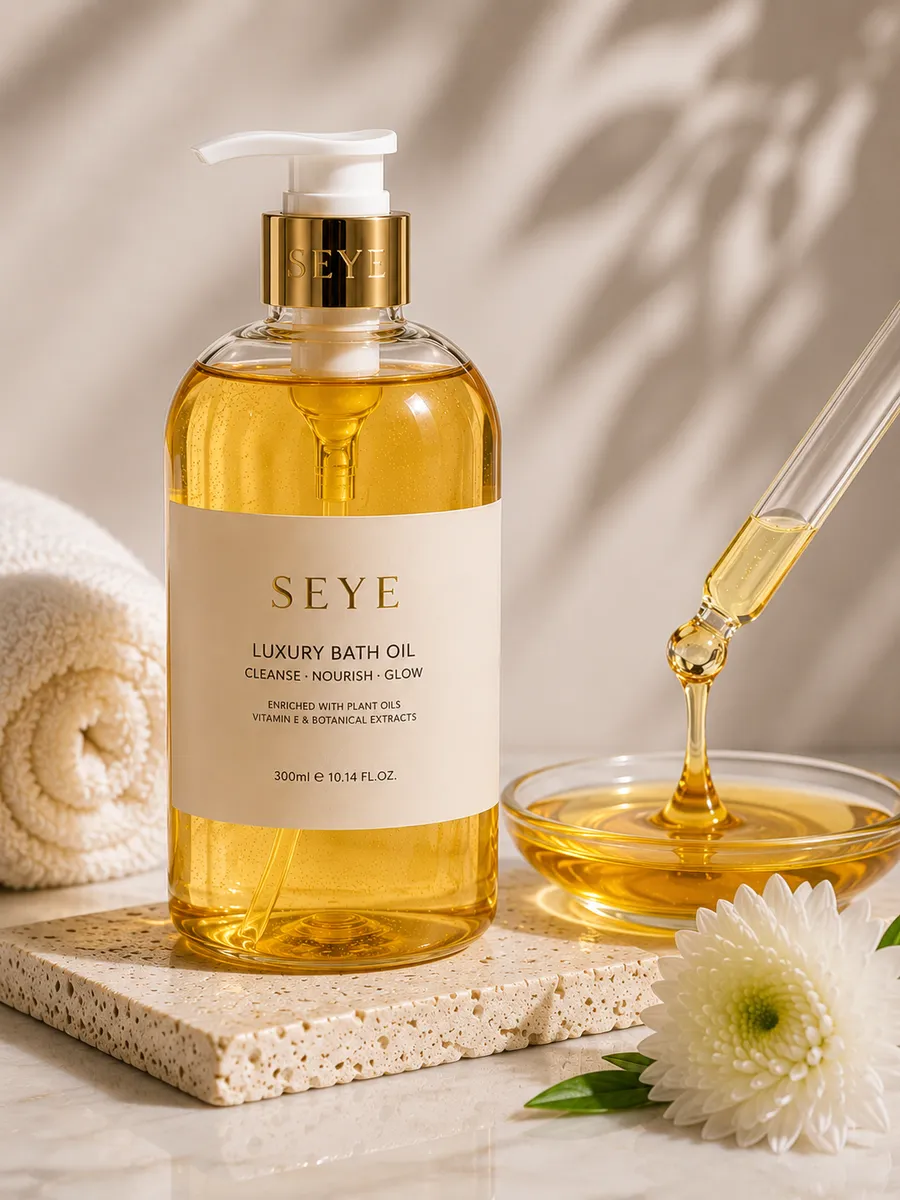
The skinification trend creates a clear opportunity for brands to differentiate through active ingredient positioning. SEYE's Luxury Bath Oil demonstrates this approach with a four-pillar active system:
| Active | Function | Consumer Benefit |
|---|---|---|
| Squalane | Lightweight emollient | Supports skin softness without greasiness |
| Jojoba Seed Oil | Skin-compatible wax ester | Helps maintain skin comfort |
| Niacinamide | Multi-functional active | Supports a healthy-looking, radiant glow |
| Ceramide NP | Barrier lipid | Helps maintain skin barrier integrity |
This active architecture allows a single product to address multiple consumer concerns — hydration, barrier support, radiance, and sensory luxury — within a single cleansing step. For private label brands, this multi-benefit positioning supports premium price points and reduces the need for consumers to layer multiple products.
Regional Market Differentiation
One of the most significant strategic considerations for bath oil OEM is regional market differentiation. Consumer preferences for texture, fragrance intensity, and active positioning vary substantially across the USA, Europe, the Middle East, and Southeast Asia.
USA & Europe markets favour clean beauty positioning, with an emphasis on barrier-supporting actives such as Ceramide NP and Squalane. Fragrance profiles tend toward understated botanical or unscented options, and sustainable packaging is a meaningful purchase driver.
Middle East markets have a strong cultural tradition of luxury bathing rituals. Products positioned as spa-inspired or gift-set-ready perform well, and richer fragrance profiles — oud, rose, amber — align with regional preferences. Premium packaging with gold accents resonates strongly.
Southeast Asia markets prioritise lightweight textures and fresh, clean rinse-off profiles. The emulsifying bath oil format is particularly well-suited to this market, as it delivers nourishment without the heavy feel that can be uncomfortable in humid climates.
SEYE's OEM team works with brands to customise fragrance direction, active levels, and packaging for each target market, allowing a single base formula to be adapted into a regionally optimised product line.
Why the Emulsifying Format Is a Commercial Advantage
Beyond the consumer experience, the emulsifying bath oil format offers meaningful commercial advantages for private label brands.
Perceived value: The oil-to-milk transformation is a visible demonstration of product quality that supports premium retail pricing. Products in this category routinely retail at two to three times the price of standard shower gels.
Differentiation: Despite strong consumer demand, the emulsifying bath oil category remains underpenetrated in many markets, particularly in the mass-premium segment. This creates a first-mover opportunity for private label brands willing to invest in the category.
Cross-category positioning: Luxury bath oil occupies a unique position between body wash and body oil, allowing brands to introduce it as either a standalone hero product or as part of a broader body care ritual collection.
Gift set potential: The visual appeal of golden oil in clear glass packaging makes luxury bath oil a natural fit for gift sets — a high-margin channel that is particularly strong in the Middle East and during seasonal gifting periods globally.
OEM Considerations: What to Look for in a Manufacturing Partner
Launching a private label luxury bath oil requires a manufacturing partner with specific capabilities. The emulsifying mechanism demands precise formulation expertise — the balance between emulsifying esters, carrier oils, and actives must be carefully calibrated to achieve the desired transformation texture, rinse-off profile, and stability.
Key criteria for evaluating an OEM partner include:
Formulation flexibility: The ability to customise fragrance, active levels, and texture profile for different regional markets. A partner with an in-house R&D team — rather than relying solely on off-the-shelf bases — offers significantly greater differentiation potential.
Certifications: GMP certification and ISO 22716 compliance are the baseline requirements for export to the USA and Europe. EU CPNP support and FDA registration capabilities are essential for brands targeting these markets.
MOQ and lead time: Flexible MOQ (from 500 units) and fast sample dispatch (48 hours) are critical for brands in the early stages of market testing or building a multi-SKU body care line.
Packaging support: The visual presentation of a luxury bath oil is a core part of its brand proposition. A manufacturing partner with packaging design support — including clear glass pump bottles, frosted glass, and gift set configurations — reduces the complexity of the product development process.
SEYE's Luxury Bath Oil OEM programme is designed to address all of these requirements, with a GMP / ISO 22716 certified facility, 30+ in-house scientists, and 26+ automated production lines delivering over 50 million units annually.
The Wellness Ritual Economy
The broader context for bath oil's resurgence is the wellness ritual economy — a consumer shift toward investing in daily self-care routines as a form of stress management and mental wellness. Research from the Global Wellness Institute places the wellness industry at over USD 4.5 trillion, with personal care and beauty representing one of the fastest-growing segments.
For bath and body brands, this shift creates a powerful narrative framework. A luxury bath oil is not simply a cleansing product — it is a daily ritual, a moment of intentional self-care, a spa experience that fits within a busy schedule. This narrative supports premium pricing, builds brand loyalty, and creates a natural content marketing opportunity across social platforms.
Brands that successfully position their bath oil within the wellness ritual economy — rather than competing on functional claims alone — consistently achieve stronger consumer engagement and higher repeat purchase rates.
Getting Started
The private label bath oil opportunity is well-timed. Consumer demand is established and growing, the category remains underpenetrated in the mass-premium segment, and the emulsifying format offers a compelling point of differentiation that supports premium pricing.
For brands ready to explore the category, the first step is sampling. SEYE dispatches samples within 48 hours, allowing brands to evaluate texture, fragrance, and rinse-off profile before committing to a production run. Custom fragrance development and active system adjustments can be incorporated at the sampling stage, ensuring the final product is precisely aligned with your brand positioning and target market.
Request a sample or OEM consultation to begin your luxury bath oil development.
Frequently Asked Questions
What is the minimum order quantity for private label luxury bath oil? SEYE supports MOQ from 500 units per formula. For brands launching multiple SKUs or regional variants, the MOQ applies per formula.
How long does it take to develop a custom fragrance for a bath oil? Standard fragrance selection from SEYE's existing library can be completed within the sampling phase (48-hour dispatch). Custom fragrance development from brief typically adds 2–4 weeks to the development timeline.
What packaging formats are available? Standard options include clear glass pump bottles, frosted glass bottles, and gift set configurations with gold pump collar accents. Custom outer box and label design support is available.
Is the formula suitable for sensitive skin? The standard formula is designed for all skin types. Fragrance-free and hypoallergenic variants can be developed upon request.
What export documentation is provided? SEYE provides COA (Certificate of Analysis), MSDS, stability testing support, and full export documentation for global markets including the USA, Europe, the Middle East, and Southeast Asia.
SEYE R&D Team
Formulation & OEM Specialists
Publication details are shown from the article record. Individual expertise, reviewer information, and review dates appear only when verified for public display.