A practical guide to understanding why a commercial skincare batch can feel slightly different from an approved lab sample. Learn how to distinguish controlled production variation from an uncontrolled deviation before accepting bulk goods.
The Short Answer: Controlled Variation Is Different From an Uncontrolled Deviation
You approve a skincare sample. A few weeks later, commercial production is completed and the texture feels slightly different. Is something wrong? Not necessarily. A laboratory sample and a commercial batch should follow the same approved formula and quality standards, but expecting every physical and sensory characteristic to be absolutely identical is not always realistic at a different production scale.
The useful buyer question is not simply “Is it identical?” It is: “Does the commercial batch still conform to the approved formula, written specifications, and intended product experience?” Normal, controlled variation can be acceptable; an uncontrolled deviation is not.
The strongest acceptance standard combines an approved reference sample with written, lot-specific specifications and a documented batch-release decision.
The Low-MOQ Samples to First Order timeline and responsibility matrix shows where the brand, OEM, packaging supplier, and quality team should agree that standard before a batch is scheduled.
Key Takeaways
- Production scale changes the manufacturing environment: mixing, homogenization, heating, and cooling can behave differently at laboratory versus commercial size.
- Raw materials—especially botanical-derived materials—can show normal lot-to-lot variation in colour, odour, and appearance.
- Temperature and time after shipping can temporarily affect how a cream, gel, or emulsion feels; compare products under agreed conditions.
- Packaging can change the user experience even when the formula is unchanged. A pump dose, airless pack, jar, or applicator changes how much product reaches the skin.
- A reference sample gives the sensory benchmark; a written specification defines the measurable boundaries.
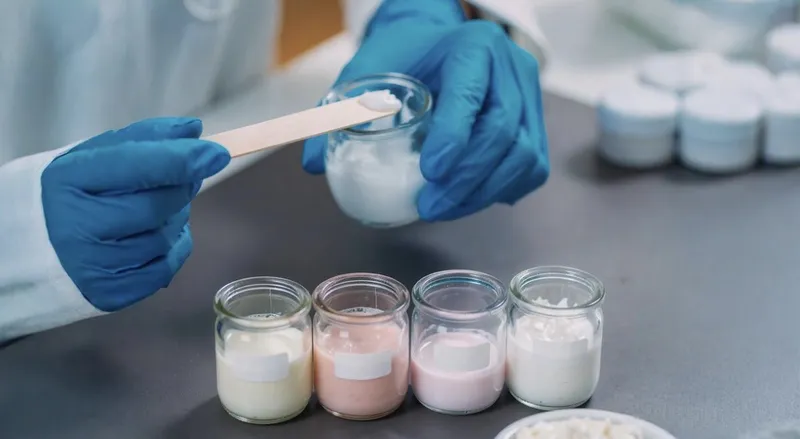
A reference sample sets the sensory benchmark; the specification sets the measurable boundaries around it.
Why Scaling Up Can Change How a Product Feels
An approved laboratory sample is an essential decision point, but it is not a miniature commercial line. The formula can be the same while the production environment changes. A well-managed scale-up anticipates those differences, documents the target conditions, and confirms that the completed batch remains within the agreed acceptance criteria.
| Scale-up factor | Why it can influence the product experience | What the buyer should agree before production |
|---|---|---|
| Mixing and shear | A larger vessel and different mixing geometry can affect dispersion, emulsion structure, viscosity, and spreadability | Product-specific process targets and the in-process checks that will be recorded |
| Heating and cooling | A commercial batch heats and cools across a larger mass, potentially affecting texture or equilibration time | Relevant temperature/time ranges and when final comparison is made |
| Raw-material lots | Natural or botanical-derived materials can vary in colour, odour, or appearance between qualified lots | Incoming-control criteria and which attributes are important to the final sensory profile |
| Filling and packaging | Dispense volume, closure, headspace, and pack material affect use and perceived texture | The final pack, artwork version, pump/closure specification, and fill-volume acceptance method |
| Storage and transport | Heat, cold, and settling can affect short-term sensory perception after shipping | Storage instructions, conditioning time, and the conditions for acceptance comparison |
For a new SKU, use the Custom Formula Development workflow to define the formula, sensory target, final packaging, and manufacturing controls together—rather than treating lab approval and commercial readiness as the same milestone.
Five Reasons a Bulk Batch Can Feel Different
1. Commercial Scale Changes Mixing Behaviour
Shear, mixing time, vessel geometry, homogenization, and heating/cooling behaviour may influence viscosity, spreadability, and richness at commercial scale. That does not automatically mean the formula changed. The relevant question is whether the process followed the approved instructions and whether the batch meets its agreed finished-product specifications.
2. Raw-Material Lots Can Vary Within Accepted Limits
Botanical-derived or naturally variable inputs may contribute small differences in colour, odour, or appearance. A controlled OEM manages this through supplier qualification, incoming inspection, lot identification, and product-specific acceptance criteria. FDA cosmetics GMP guidance describes controls over materials, production instructions, testing, and batch records as parts of a quality system.1
3. Temperature at Delivery Can Affect a First Impression
A cream may feel thicker after exposure to cold; a gel can feel different after heat exposure. Let the product return to its normal storage condition before a final sensory comparison. The comparison should use the agreed conditioning time and test conditions, not two products evaluated in different environments.
4. Equilibration Can Continue After Manufacturing
Some emulsions and gels settle into their final physical state after production. Quality control should use defined testing conditions and documented specifications rather than a casual comparison at unrelated points in time. If the product was developed for a particular market or climate, align the stability, packaging, and transport discussion with the Global Compliance for Cosmetics workstream.
5. Packaging Can Be the Difference the Customer Notices
A lab sample in a simple jar and a final product in an airless pump can deliver a different dose and application experience. Before treating a sensory difference as a formula issue, confirm the final packaging format, actuator output, fill volume, and use instructions. The Private Label Facial Serum page illustrates how format and dispensing should be considered together with the formula brief.
Acceptable Variation Versus Red Flags
| Potentially acceptable when within specification | Should raise questions before acceptance |
|---|---|
| Subtle colour variation within the approved specification | Obvious separation, leakage, or a failed pump/closure |
| Slight viscosity variation within the documented range | A significant viscosity shift outside the agreed range |
| Minor natural odour variation within the approved profile | A clearly different fragrance or unexpected off-odour |
| Small sensory differences consistent with the reference profile | Unexpected particles, major colour change, or an altered use experience |
| Expected yield or settling explained in controlled records | A difference that cannot be linked to process, specification, packaging, or an authorized investigation |
If an approved sample was a lightweight gel-cream and the bulk arrives as a heavy, sticky cream, that should not be dismissed as “normal variation.” Ask the manufacturer to investigate the formula version, material lots, process record, packaging configuration, and finished-product results.
Build the Right Acceptance Standard: Reference Sample + Written Specification
An approved reference sample captures the target appearance, texture, colour, odour, spreadability, and overall sensory profile. A written product specification captures measurable or controlled criteria such as pH, viscosity, appearance, fill quantity, microbiological controls where applicable, and packaging performance. Neither should replace the other.
Before production, document the following questions:
- Which approved sample is the official reference sample, and how will it be labelled, stored, and retrieved?
- What are the finished-product specifications, test conditions, methods, and acceptance ranges?
- Which quality-control parameters will be checked in bulk, during filling, and at final release?
- What variation is expected and acceptable, and what event triggers an investigation?
- Which batch documents will be shared before shipment, and which role authorizes release?
“Please make sure it is exactly the same” is less useful than these specific, reviewable requirements. The COA, batch-record, and release-document guide explains how to check whether the evidence package actually links the approved formula, lot, results, exceptions, and release decision.
A Simple Example of Controlled Variation
Imagine an approved sample described as a white gel-cream with a lightweight, low-tack finish, an agreed pH range, and medium viscosity. The first bulk check feels slightly thicker. The manufacturer then verifies that the correct formula version was used, the viscosity remains within specification, pH passes, appearance and odour meet the approved profile, the microbiological requirements are met where applicable, and the final package dispenses consistently.
That can represent controlled variation. By contrast, a bulk batch that becomes substantially thicker, yellow instead of white, strongly different in odour, or visibly separated needs an investigation. The acceptance standard is not perfect sensory duplication in isolation; it is conformity to the approved formula, specification, intended experience, and controlled quality evidence.
What to Do Before You Approve Bulk Production
| Project gate | Brand responsibility | OEM responsibility | Evidence to retain |
|---|---|---|---|
| Sample approval | Approve the intended formula, sensory target, and final pack direction | Record the sample and relevant version | Dated approval record and identified reference sample |
| Pre-production review | Confirm criteria, target market, packaging, and delivery plan | Confirm production instruction, materials, line availability, and quality plan | Signed specification, artwork/pack approval, production brief |
| Batch review | Review agreed COA/QC documents and ask about exceptions | Complete batch controls, test/examine as required, and issue controlled disposition | Batch record, COA or test summary, deviation record where applicable, release status |
| Goods acceptance | Check physical batch codes, packaging, quantity, and product condition | Provide agreed shipment and quality documents | Acceptance record, photos, quantity reconciliation, document archive |
The First Production Acceptance and Replenishment Decision Checklist turns this quality evidence into a practical arrival, quarantine, sellable-inventory, and reorder process. For low-MOQ orders, pair that approach with the hidden-cost and lead-time guide so that packaging readiness, yield assumptions, and change-control decisions are clear before the production window is locked.
When a Difference Needs a Formal Investigation
Ask for a controlled investigation when the batch is outside specification, differs materially from the approved product profile, shows a packaging defect, or has an unexplained mismatch in records. A useful investigation should identify the affected lot, compare the approved and actual formula/pack versions, review material lots and process conditions, record any deviation, assess the quality impact, and document the disposition.
This is also why a buyer should check the factory’s quality-system evidence before placing an order. The cosmetic OEM certificate and audit-document guide explains how to review certificates, scope, audit records, and corrective-action evidence without confusing them with batch-specific proof.
Frequently Asked Questions
Should bulk skincare be the same as the approved sample?
It should conform to the approved formula, product specifications, and sensory target. Minor controlled variation can occur in commercial manufacturing, but a material difference should be investigated against the defined acceptance criteria.
Does a slight viscosity difference mean the formula changed?
Not necessarily. Temperature, manufacturing scale, equilibration time, and test conditions can affect viscosity. Compare the result against the agreed specification under appropriate conditions and review the batch evidence if it falls outside range.
Can a manufacturer change the formula after sample approval?
Meaningful formula changes should not be made without appropriate review and approval. Buyers should require clear version control and a documented change-control process for formula, materials, packaging, and artwork.
What if the bulk is clearly different from the sample?
Ask the manufacturer to investigate the batch against the approved formula, reference sample, material lots, production records, packaging configuration, and finished-product specifications. Do not accept an unexplained difference as routine variation.
Who should confirm which QC parameters will be checked on the bulk batch?
The brand and manufacturer should agree this before production. The agreement should define the relevant finished-product specifications, test conditions, acceptance criteria, document copies, and what happens if a batch is outside specification.
Should I approve bulk against a reference sample or a written specification?
Use both. The reference sample provides the sensory and visual target, while the written specification sets measurable or controlled boundaries. Combined with the batch and release documents, they create a more reliable acceptance standard.
Moving From Sample to Commercial Production?
SEYE can help define the approved formula, reference sample, product specification, packaging configuration, and batch-QC requirements before commercial manufacturing begins. Discuss your production standards with the OEM team.
References
SEYE Cosmetics
OEM Formulation & Quality Advisory Team, SEYE Cosmetics
Publication details are shown from the article record. Individual expertise, reviewer information, and review dates appear only when verified for public display.