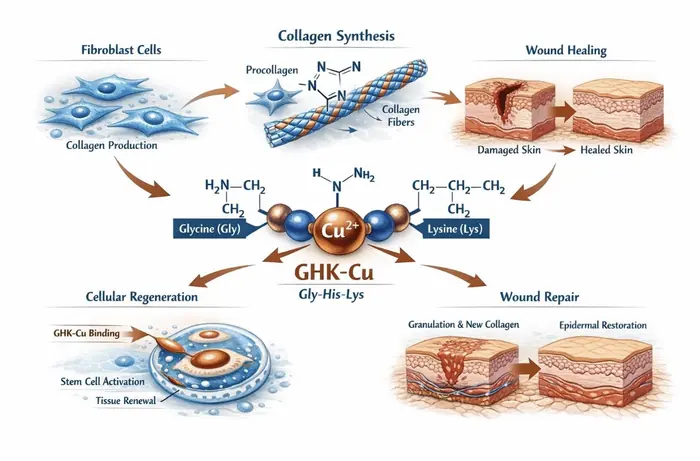
Copper peptides and retinol do not solve the same product-development problem. This evidence-led guide compares their mechanism, evidence context, tolerance profile, formulation risk, packaging, claims, and OEM decision path.
Quick Answer
Copper peptides and retinol are not interchangeable anti-aging ingredients. Retinol is a vitamin A derivative that must be converted in skin to retinoic acid; it has a broader cosmetic and dermatology evidence base, but brings well-known stability and tolerability questions. Copper Tripeptide-1 (GHK-Cu) is a copper-binding tripeptide associated with skin-repair and matrix-related research, but its topical clinical evidence base is smaller and should not be positioned as a direct substitute for prescription retinoids.
For a brand, the choice is therefore not “which ingredient wins?” It is which product promise, consumer tolerance profile, formula architecture, package, and substantiation plan should lead the launch. 1 2

Choose the system—not the headline ingredient. A credible launch aligns active, vehicle, packaging, use instructions, stability program, and claim evidence.
Copper Peptide vs Retinol at a Glance
| Decision area | Copper Tripeptide-1 (GHK-Cu) | Retinol |
|---|---|---|
| Ingredient class | Copper-binding tripeptide | Vitamin A derivative / cosmetic retinoid |
| Development story | Supports a repair- and matrix-oriented positioning | Supports a renewal- and visible-photoaging positioning |
| Evidence context | Mechanistic work and smaller topical studies; evidence must be framed carefully | More studied cosmetic retinoid, though evidence for individual cosmetic formulas remains formulation-specific |
| Key formulation priority | Compatibility, pH, color profile, and process control | Protection from light and oxygen; vehicle, release profile, and tolerance strategy |
| Main consumer-use question | Can the formula remain stable and elegant throughout use? | Can the brand balance use experience, tolerance, and expected results? |
| Commercial role | Barrier-support, recovery, or peptide-led premium routine | Night-renewal or texture-focused product platform |
The table is a product-development comparison, not a clinical ranking. It is particularly important to distinguish cosmetic retinol from prescription tretinoin: they are related compounds but are not equivalent in regulatory status, activity, or permitted communication. 2 3
What Is Actually Being Compared?
Retinol: a conversion-dependent retinoid
Retinol is a first-generation retinoid used in cosmetics. After topical application it is converted through retinaldehyde to biologically active retinoic acid, so a formula’s observed performance depends on concentration, delivery system, stability, use pattern, and the consumer’s own skin biology. Reviews of topical retinoids describe retinoid-receptor signaling, effects on keratinocyte biology, and a large body of research around photoaging; they also note that the evidence for a particular cosmetic formula should not be assumed from the ingredient name alone. 2 4
For an OEM brief, this makes “0.X% retinol” an incomplete specification. The brief should state the retinol source, target level at release and shelf life, antioxidant and chelation strategy, pack type, application frequency, expected sensory profile, target market, and consumer instructions. Our retinol OEM formulation guide explains why the formulation pathway matters as much as the percentage on the label.
Copper Tripeptide-1: a peptide-led repair narrative
Copper Tripeptide-1, often called GHK-Cu, is a small copper-binding peptide. Published reviews describe research related to fibroblasts, extracellular-matrix-associated processes, and topical studies of visible skin attributes. However, the clinical record is smaller and more heterogeneous than the retinoid literature. That is a reason for precise claim language and product-specific testing, not for exaggerated “retinol replacement” messaging. 1
Before product planning, brand teams can review our complete GHK-Cu guide and the analysis of why some Copper Peptide products succeed or fail. Together, they help translate a popular ingredient into practical questions about the total product system.
Evidence: Do Not Turn a Comparison into a Superiority Claim
The most useful comparison is not a scorecard of isolated studies. Retinol and copper peptide studies vary by molecule, concentration, vehicle, comparator, study duration, endpoints, and sponsorship. A positive result in a specific formula does not prove that every formula carrying the same ingredient will deliver the same outcome.
| Evidence question | Responsible interpretation for a brand |
|---|---|
| Is there ingredient-level research? | It can inform the product rationale, but it does not replace testing of the finished formula. |
| Is there a direct, appropriately designed comparison? | Avoid claiming one ingredient is superior unless the specific evidence and jurisdiction support that statement. |
| Does the finished product have substantiation? | Align visible claims with the actual formula, consumer study, instrumental work, and target-market requirements. |
| Are prescription-retinoid results being cited? | Do not use them to imply that a cosmetic retinol serum is a prescription medicine. |
This discipline protects both conversion quality and regulatory readiness. Use the site’s cosmetic claim substantiation framework to match a product promise to the available evidence before committing to product-page copy or packaging artwork.
Tolerability and Routine Design
Topical retinoids can be associated with dryness, erythema, peeling, and irritant dermatitis; risk and experience vary by molecule, strength, vehicle, frequency, consumer skin condition, and routine. Retinol is commonly regarded as less irritating than tretinoin, but it is not tolerance-free. Responsible cosmetics communication should encourage appropriate nighttime use, a gradual introduction where suitable, daily sun protection, and professional advice when consumers have a medical concern. 2 3
Copper peptide products offer a different routine narrative. They may suit a barrier-conscious, recovery-oriented, or premium peptide portfolio, but their consumer experience still depends on the complete formula. Do not treat “copper peptide” as a universal sensitive-skin claim without finished-formula safety and compatibility work.
For a brand launching to consumers with varied experience levels, the practical choice may be a routine architecture rather than one active replacing the other:
- A retinol-focused night serum can lead a renewal-oriented range.
- A copper peptide serum can anchor a peptide and recovery-oriented range.
- Separate SKUs can offer clearer product education and a simpler stability program.
- A combined formula can be explored only after compatibility, stability, safety, and use-experience testing support it.
Formulation and Packaging: Where Commercial Success Is Decided
Retinol is susceptible to light and oxygen, making its formulation and packaging strategy central to product quality. Literature on topical retinoids highlights instability, penetration limits, and irritation as recurring formulation challenges; opaque, oxygen-conscious packaging and a purposeful vehicle are therefore part of the active-delivery system, not an afterthought. 2
Copper Tripeptide-1 products have a different set of controls. Brands should ask how the ingredient behaves at the planned pH, alongside the selected preservative system and other actives, during mixing and scale-up, and after prolonged contact with the primary package. Appearance changes, pH drift, dispensing behavior, and batch-to-batch consistency should be reviewed in the development plan.
| Development checkpoint | Retinol-led formula | Copper peptide-led formula |
|---|---|---|
| Bench screening | Assay, color/odor, vehicle compatibility, preliminary tolerance strategy | Peptide dispersion, pH window, color profile, compatibility screen |
| Pilot batch | Light/oxygen exposure, fill conditions, batch reproducibility | Mixing order, temperature exposure, visual consistency, batch reproducibility |
| Pack validation | Opaque or protective pack; dose control and air exposure | Pump/dropper compatibility, material interaction, visual profile through use |
| Release plan | Active retention and product appearance against specification | Identity/appearance, pH, process controls, and stability against specification |
A private-label facial serum platform can provide a starting point for texture and pack decisions, but the final development route should be customized to the actives, market, and target claim. Brands needing that coordination can begin with custom formula development.
Which Launch Strategy Fits Your Brand?
Choose a retinol-led product when the brief requires
A retinol-led formula may fit a brand looking for a recognizable night-renewal category, with an education plan that addresses use frequency, daylight routine, and tolerance. The development investment should prioritize active retention through shelf life, packaging protection, and a realistic claims package.
Choose a copper peptide-led product when the brief requires
A copper peptide-led formula may fit a premium peptide story centered on visibly smoother-, firmer-, or more resilient-looking skin, provided each claim is substantiated for the finished product. The development investment should prioritize formula compatibility, aesthetic consistency, and a non-exaggerated evidence narrative.
Consider a portfolio, not a forced combination
Two clearly differentiated products often make commercial and technical sense: one retinol night serum and one copper peptide or barrier-support serum. This creates opportunity for cross-selling while allowing each formula, instruction set, and claims dossier to be evaluated on its own merits. A combination product should be a deliberate formulation project—not a response to an ingredient trend.
Claims and Global Market Readiness
The label claim is not the development brief. Ingredients, concentration, target markets, testing plan, packaging claims, and regulatory classification should be aligned from the first prototype. For example, avoid wording that implies diagnosis, treatment, or prescription-level performance for a cosmetic retinol product; do not claim that a copper peptide product “replaces” a retinoid without defensible evidence.
Brands selling across markets should also identify local restrictions, labeling expectations, safety assessment needs, and evidence requirements before final artwork. Our global cosmetics compliance hub outlines the cross-functional workstream that should run alongside formula development.
A Decision Framework for Your OEM Brief
Use these questions before asking a manufacturer for a quotation:
- What is the single consumer-facing job of the product? Night renewal, a peptide-led premium serum, visible texture support, or portfolio expansion?
- Who is the target user? Experienced active users, a broad beauty audience, or a barrier-conscious segment?
- What is the commercial format? One hero SKU, a two-step regimen, or a broader active-serum collection?
- What evidence will support the copy? Ingredient rationale only, a consumer-use study, instrumental assessment, or a combination appropriate to the market?
- What will be tested before launch? Formula stability, packaging compatibility, microbiological quality, safety, and claims substantiation appropriate to the product.
Frequently Asked Questions
Is Copper Peptide better than Retinol?
Neither ingredient is universally “better.” They have different product-development roles, evidence bases, and formulation considerations. A finished product should be chosen and substantiated around the target consumer and promise rather than ingredient popularity.
Is cosmetic retinol the same as prescription tretinoin?
No. Retinol is converted in skin to retinoic acid, while tretinoin is retinoic acid and is regulated as a medicine in many markets. Brands should not use prescription-tretinoin evidence to imply equivalent performance for a cosmetic retinol product. 2 3
Can a brand combine Copper Peptide and Retinol in one serum?
It can be explored, but it should be treated as a complete formulation project. The manufacturer should assess ingredient compatibility, stability, package interaction, safety, sensory performance, and the finished formula’s claim support before launch.
What packaging is suitable for a retinol serum?
The appropriate format depends on the formula, but the development plan should address retinol’s sensitivity to light and oxygen. Packaging compatibility and stability testing are needed before commercial selection.
What should be tested for a Copper Peptide serum?
At minimum, the program should address finished-formula stability, pH and appearance controls, packaging compatibility, microbiological quality, safety, and the evidence required for proposed cosmetic claims.
How should brands phrase anti-aging claims responsibly?
Claims should reflect the finished product’s substantiation and local rules. Cosmetic wording about the appearance of fine lines, texture, firmness, or radiance is not the same as therapeutic or prescription-level claims.
Plan a Formula That Matches the Promise
SEYE can help map an active-serum concept from ingredient rationale through pilot production, stability, packaging, and claims readiness. Contact our OEM team with your intended market, texture, pack format, target consumer, and active concept to discuss a development path.
References
SEYE Cosmetics
Formulation & Product Development Team, SEYE Cosmetics
Publication details are shown from the article record. Individual expertise, reviewer information, and review dates appear only when verified for public display.