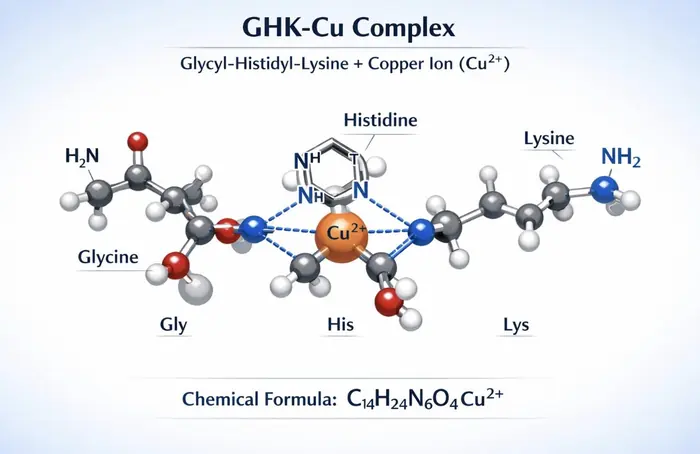
Copper Tripeptide-1 (GHK-Cu) does not act as a simple collagen booster. Current research describes it as a multifunctional signaling peptide that influences extracellular matrix remodeling and fibroblast activity — not a single-target ingredient.
Copper Tripeptide-1 (GHK-Cu) is one of the most discussed actives in modern skincare, yet it is also one of the most frequently misrepresented. Many brands describe it simply as a "collagen booster" — but the actual science is considerably more nuanced.
Quick Answer
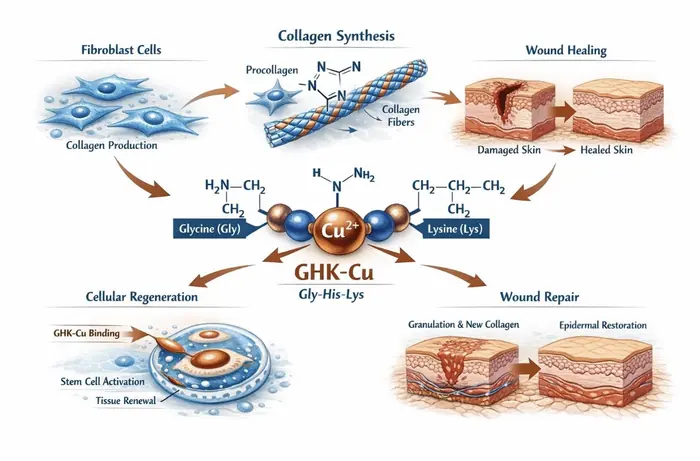
GHK-Cu does not act as a simple "collagen booster." Current research describes it as a multifunctional signaling peptide that influences several interconnected pathways — most notably extracellular matrix remodeling and fibroblast activity — rather than a single-target ingredient.
Key Takeaways
- GHK-Cu influences multiple biological pathways, not one single mechanism.
- It appears to support balanced extracellular matrix remodeling rather than simply boosting collagen.
- Laboratory evidence for fibroblast support is strong; human clinical evidence is moderate.
- Formulation stability directly affects whether these mechanisms translate into real-world performance.
- Marketing claims should reflect the actual strength of evidence for each mechanism.
Why This Matters for Skincare Brands
Many skincare ads simplify GHK-Cu's activity by claiming it "creates collagen." The science is more nuanced — collagen synthesis is only one part of a broader extracellular matrix remodeling process.
Understanding the actual mechanisms helps brands write claims that are both scientifically accurate and compliant with cosmetic regulations in major markets. For a deeper look at compliance requirements, see our EU cosmetics compliance guide for private label brands.
The Core Mechanisms
Research into GHK-Cu has identified two primary pathways through which it appears to exert its effects:
- Extracellular matrix (ECM) remodeling — GHK-Cu may help fibroblasts produce structural proteins while regulating matrix metalloproteinases (MMPs) and tissue inhibitors of metalloproteinases (TIMPs) that control matrix degradation. This is a balancing effect, not a one-directional boost.
- Fibroblast activity support — GHK-Cu appears to support a cellular environment favorable to normal fibroblast function, rather than forcing continuous collagen output. Fibroblasts produce collagen, hyaluronic acid, and proteoglycans within the extracellular matrix.

Evidence Strength by Mechanism
Not all evidence is equal. Understanding the evidence tier behind each mechanism is critical for writing defensible marketing claims:
| Research Type | ECM Remodeling | Fibroblast Activity |
|---|---|---|
| In Vitro Studies | Strong | Strong |
| Animal Studies | Strong | Moderate |
| Human Clinical Studies | Moderate | Moderate |
| Scientific Consensus | Moderate to Strong | Moderate |
ECM remodeling is consistently strong across in vitro and animal research, with human clinical evidence rated moderate — making it the more defensible of the two mechanisms for marketing language. Fibroblast activity has strong in vitro support that tapers to moderate in both animal and human studies — frame this as "supports a favorable cellular environment," not a guaranteed output increase.
Writing Accurate Claims
Based on the evidence landscape, here are practical guidelines for brand teams:
- Avoid stating GHK-Cu "creates collagen" — describe it as supporting matrix remodeling instead.
- Distinguish laboratory findings from confirmed human clinical outcomes in marketing copy.
- Pair ingredient claims with finished-product testing wherever possible.
This is especially important for brands targeting EU and US markets. Our peptide and retinol anti-aging serum OEM guide covers how to position peptide-based products compliantly across different regulatory frameworks.
OEM Development Considerations
The biological activity observed in lab studies depends on delivering an intact GHK-Cu complex to the skin. Excessive heat, inappropriate pH, incompatible ingredients, or long processing times can all reduce stability before the product ever reaches consumers.
For brands developing premium copper peptide products, formulation partner selection matters as much as ingredient selection. This connects directly to the formulation variables we cover in our article on why formulation matters more than the active ingredient.
If you are new to the copper peptide category, our complete guide to Copper Tripeptide-1 (GHK-Cu) provides a full overview of the science, evidence, and OEM development pathway. And for the broader biological functions beyond collagen, see our article on GHK-Cu's biological functions beyond collagen.
Frequently Asked Questions
Does Copper Tripeptide-1 directly increase collagen production?
Current evidence suggests it supports broader extracellular matrix remodeling, of which collagen synthesis is only one component — not a direct, isolated collagen boost.
Is the evidence for GHK-Cu based mostly on lab studies?
In vitro and animal evidence is strong for both extracellular matrix remodeling and fibroblast activity; human clinical evidence for both is currently rated moderate.
Why do fibroblasts matter for skin aging?
Fibroblasts produce the structural components that maintain skin strength and elasticity. As fibroblast activity declines with age, collagen production and tissue repair slow down.
How does formulation affect whether these mechanisms actually work in a finished product?
If the copper-peptide complex degrades during manufacturing or storage due to heat, pH, or incompatible ingredients, the biological activity demonstrated in lab studies may not carry through to the finished product.
Should marketing copy cite in vitro studies at all?
It can, as long as the copy is clear the finding is laboratory-based rather than a proven human outcome — pairing mechanism-level language with appropriate hedging keeps the claim defensible.
Developing a Copper Peptide Product?
At SEYE Cosmetics, our formulation team evaluates ingredient compatibility, stability, and manufacturing feasibility throughout the OEM development process. We work with brands at every stage — from initial concept to finished product stability testing. Contact us to discuss your copper peptide formulation requirements.
SEYE R&D Team
Formulation & OEM Specialists
Publication details are shown from the article record. Individual expertise, reviewer information, and review dates appear only when verified for public display.