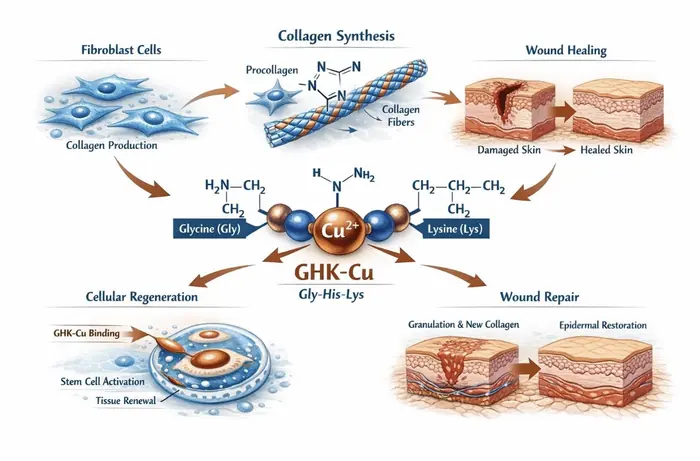
Copper Tripeptide-1 (GHK-Cu) is one of the most discussed actives in modern skincare — and one of the most misunderstood. This complete guide covers the science, evidence strength, formulation challenges, and OEM development considerations every brand should know.
The Complete Guide to Copper Tripeptide-1 (GHK-Cu): Science, Evidence & OEM Development
Quick Answer
Copper Tripeptide-1 (GHK-Cu) is a naturally occurring copper-binding peptide widely used in anti-aging, barrier repair, and post-procedure skincare. Its biochemical properties are well established, but cosmetic performance claims vary in evidence strength. For OEM brands, raw material qualification is the starting point — not the finish line. Formulation quality ultimately determines whether a copper peptide product performs as marketed.
Key Takeaways
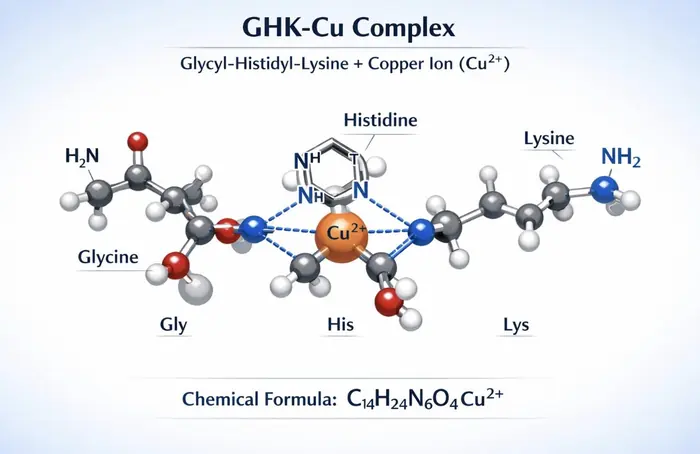
- GHK-Cu is composed of glycine, histidine, and lysine bound to a copper ion — and occurs naturally in the human body.
- It was first identified in 1973 and has decades of published research behind it.
- Color intensity does not confirm ingredient concentration or biological activity.
- Raw material qualification is the starting point of OEM development, not the finish line.
- Formulation and manufacturing quality determine whether a copper peptide product performs as marketed.
Why This Matters for Skincare Brands
Copper Tripeptide-1 has become one of the most discussed active ingredients in modern skincare, appearing in serums, creams, eye treatments, and scalp products. It is also one of the most misunderstood.
Many articles focus almost entirely on biological activity while overlooking formulation quality — the factor that actually determines whether a copper peptide product performs consistently once it reaches consumers. For brands developing peptide and retinol anti-aging serums, this distinction is equally critical: the active ingredient is only as effective as the formulation system that carries it.
Market Insights: What the Science Actually Shows
GHK is naturally present in human plasma, saliva, and urine. When three amino acids — glycine, histidine, and lysine — bind with a copper ion, they form the blue complex known as Copper Tripeptide-1.
- First identified in 1973 by biochemist Dr. Loren Pickart during liver tissue research.
- Later studied for wound healing, extracellular matrix remodeling, and skin repair.
- Listed under INCI and used across anti-aging, barrier repair, eye care, and scalp care products.

Comparison & Analysis: Evidence Strength at a Glance
| Research Area | Evidence Level |
|---|---|
| Copper-binding biochemistry | Strong — decades of published research |
| Wound healing / tissue repair | Well supported |
| Anti-aging cosmetic outcomes | Moderate to strong, evidence-dependent |
Biochemistry — Decades Deep
Copper-binding chemistry and wound-healing activity rest on decades of published research, making these the safest foundation for formulation and claims strategy.
Cosmetic Outcomes — Evidence-Dependent
Anti-aging cosmetic results vary in strength by specific outcome measured — general "supports skin health" language holds up better than narrow, quantified claims. For brands navigating claim substantiation in regulated markets, our EU cosmetics regulation compliance guide outlines what documentation is required.
Recommendations: Evaluating a Copper Peptide Raw Material
- Ask suppliers about purity, carrier system, and recommended pH range before formulation begins.
- Don't treat color as a proxy for concentration or activity.
- Evaluate formulation compatibility during development, not after scale-up.
Key question: Am I evaluating the raw ingredient, or the finished formulation that will actually reach consumers?
OEM Development Considerations
Different Copper Tripeptide-1 suppliers offer materials with varying purity, carrier systems, and handling requirements. These differences influence formulation compatibility and should be assessed early in development.
Raw material qualification should be treated as the starting point of a project — not the final determinant of product quality. For a deeper look at how formulation choices affect finished-product performance, see our guide on why formulation matters more than the active ingredient.
For brands planning to launch in regulated markets, our private label skincare EU compliance guide outlines the documentation requirements that apply to copper peptide claims.
Frequently Asked Questions
Is Copper Tripeptide-1 the same as "blue peptide"? The blue color comes from the copper complex itself, not an added dye — but color intensity alone should never be treated as proof of concentration or activity.
Why do formulations with the same GHK-Cu material perform differently? Differences in raw material purity, carrier system, pH environment, and manufacturing process can all influence how well the copper-peptide complex is preserved in the finished product.
What product categories commonly use Copper Tripeptide-1? Anti-aging serums, barrier repair creams, post-procedure products, eye creams, and scalp treatments are among the most common applications.
What should a brand ask an OEM manufacturer before starting a GHK-Cu project? Ask how they evaluate raw material purity, pH compatibility, stability testing, and manufacturing consistency — these factors have more influence on final product quality than the ingredient specification alone.
Does a higher published purity percentage guarantee better finished-product results? Not on its own. Purity affects raw material quality, but pH control, chelator compatibility, and manufacturing process determine whether that purity is preserved through to the finished formula.
Planning a Copper Peptide Skincare Project?
At SEYE Cosmetic, we work with skincare brands worldwide to develop private label and custom formulations built around scientifically supported active ingredients. Whether you are developing a private label facial serum or an eye cream OEM formulation featuring GHK-Cu, our formulation team provides full technical support from raw material evaluation through to finished product.
Related Reading: Beyond Collagen: The Biological Functions of Copper Tripeptide-1 · Why Formulation Matters More Than the Active Ingredient · How to Start a Skincare Brand
SEYE R&D Team
Formulation & OEM Specialists
Publication details are shown from the article record. Individual expertise, reviewer information, and review dates appear only when verified for public display.