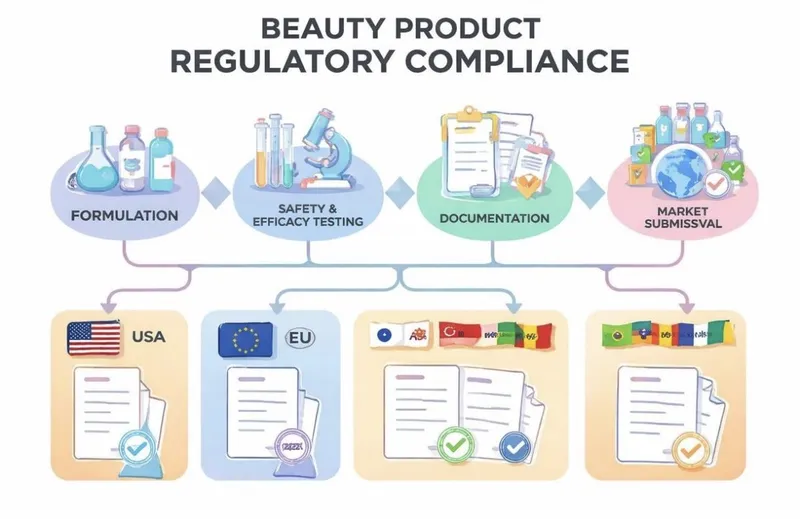
A practical procurement guide for cosmetic brands exporting from China to the EU or United States. Understand the roles of COA, MSDS/SDS, CPSR, PIF, CPNP, FDA facility registration, product listing, labels, claims, and post-market responsibilities before approving packaging or bulk production.
Export Readiness Is a System, Not a Folder of Documents
For cosmetic buyers exporting from China to the European Union or United States, product quality documents, market documentation, labelling, and post-market responsibilities are connected but not interchangeable. A certificate, factory registration, Certificate of Analysis (COA), or safety data sheet can be important evidence, yet none alone makes every finished product ready for every market.
This is a procurement checklist, not legal advice. It helps brands define which documents should be requested, who owns each submission, and which facts must be confirmed for the formula, claims, packaging, intended user, and target market before release. For a broader commercial starting point, begin with the Global Compliance for Cosmetics hub.
A compliant export project is not created at dispatch. It is built from an agreed formula, market scope, pack, claims boundary, evidence plan, named accountable parties, and controlled records.
EU and US Compliance: The Core Difference
| Topic | European Union | United States | Buyer action |
|---|---|---|---|
| Market framework | Regulation (EC) No 1223/2009 is the core framework for finished cosmetics placed on the EU market. | Cosmetics are subject to the FD&C Act, FPLA, and applicable Modernization of Cosmetics Regulation Act (MoCRA) requirements. | Define country, channel, intended user, product category, and claims boundary before formula and artwork are finalized. |
| Named accountable party | An EU-based Responsible Person is required before a cosmetic is placed on the market. | The Responsible Person is generally the manufacturer, packer, or distributor whose name appears on the label under the applicable law. | State the responsible entity and its duties in the launch plan and agreement. |
| Product notification / listing | The relevant party notifies products through the Cosmetic Products Notification Portal (CPNP). | Product listing and update responsibilities apply to the Responsible Person as required by MoCRA. | Confirm who submits, who keeps evidence, and which finished-product data are used. |
| Safety evidence | The Cosmetic Product Safety Report (CPSR) and Product Information File (PIF) are core EU documentation. | The Responsible Person maintains records supporting adequate safety substantiation. | Do not treat a raw-material certificate as a replacement for finished-product safety work. |
| Claims and labels | Claims, INCI information, warnings, and language requirements must suit the intended EU market. | Labels, safety, and claims must align with the intended cosmetic use and applicable US requirements. | Approve market-facing copy before ordering printed components. |
The European Commission explains that the EU framework requires a Responsible Person and centralised notification through CPNP. The FDA explains that a US Responsible Person has distinct duties around product listing, safety substantiation, and serious-adverse-event reporting under MoCRA.1 2
Document Checklist: What Buyers Should Request and Review
The right record set depends on the product, formula, claims, package, destination, and commercial agreement. The table below separates common evidence from claims it cannot make by itself.
| Document or record | Why it matters | What it does not prove by itself |
|---|---|---|
| COA (Certificate of Analysis) | Supports agreed batch or material specifications and recorded results. | It does not replace a finished-product safety assessment, market review, or label review. |
| MSDS / SDS | Communicates relevant hazard, handling, transport, or workplace information. | It does not automatically establish consumer-product compliance in every destination market. |
| Formula / INCI information | Supports ingredient review, labelling, compatibility, and product documentation. | It must be assessed in the context of concentration, use, claims, exposure, and applicable restrictions. |
| Stability and compatibility evidence | Supports the selected formula–package system and shelf-life decisions. | It is not a universal substitute for market-specific requirements or ongoing change control. |
| Microbiological / preservation evidence | May support quality and safety evaluation for water-based or otherwise relevant products. | It does not remove the need for a complete product safety and quality dossier. |
| CPSR and PIF components | Core EU documentation, prepared and retained under the applicable EU process. | They should not be described as complete until formula, label, Responsible Person, and market scope are confirmed. |
| Batch records and traceability data | Supports investigation, release, and post-market response. | They do not replace brand-side complaint, inventory, and adverse-event procedures. |
The most reliable time to map these files is during the product brief. The low-MOQ sample-to-first-order timeline shows how technical, packaging, documentation, and production approvals interact before a first order can be scheduled.
What SEYE Can Support—and What the Buyer Still Owns
SEYE’s public materials state that its manufacturing operation follows ISO 22716 and GMPC quality practices and identify an FDA facility-registration context. Buyers should request current certificates, registration evidence, scope, issuing body, dates, and the applicability of each document to the proposed site and product. An FDA facility registration is not FDA approval of a cosmetic product, and EU Regulation 1223/2009 is a regulatory framework rather than a factory certification.
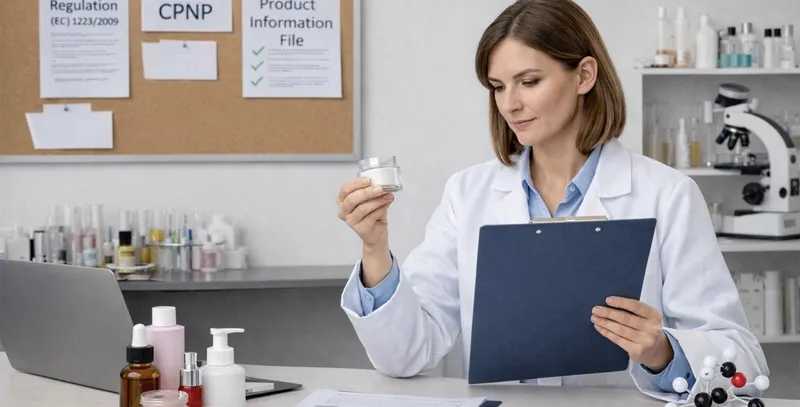
For an EU or US project, SEYE can coordinate agreed product-development inputs, batch documentation, quality records, and available technical documents. The brand, its Responsible Person, importer, distributor, and regulatory advisers must still agree who owns the final market assessment, notifications or listings, labels, claims substantiation, post-market monitoring, and change control. Visit Certifications to review the factory’s quality and registration information, and use Custom Formula Development when a product brief requires a controlled formulation route.
Compliance Workflow Before You Print Packaging
- Set market scope. Identify destination countries, intended user, product category, sales channel, and claims direction.
- Freeze the technical baseline. Confirm the formula version, INCI list, packaging, fill size, shelf-life approach, and supplier identities.
- Assign document owners. Name the brand, OEM, Responsible Person, importer, and qualified assessor or adviser responsible for each file.
- Review claim and label text. Align copy with product evidence and mandatory market information before artwork approval.
- Release only against records. Retain approved artwork, batch identifiers, technical specifications, and market files through the product lifecycle.
For statement discipline, use SEYE’s guide to cosmetic claim substantiation. For the production-side handoff, read the first-production acceptance and replenishment checklist, which explains how to reconcile received goods, packaging, records, deviations, and future reorder decisions.
Questions to Put in the OEM Agreement
- Which factory site is making the product, and which current quality documents cover that location?
- Which batch, specification, COA, SDS, testing, and packaging records will be supplied or retained, in which language and format?
- Who may change the formula, component, artwork, raw-material supplier, or process, and how is change impact assessed?
- Who owns CPNP notification, the PIF/CPSR process, US product-listing responsibilities, and adverse-event escalation?
- Which claims can be used now, what evidence supports them, and who approves final market copy?
When a project starts at a small volume, document control is also a commercial safeguard. The article From 500 to 3,000 Units: Avoid Hidden Costs and Lead-Time Traps explains why readiness conditions, packaging supply, and scope changes must be explicit before production scheduling.
A Practical Pre-Export Checklist
| Decision area | Confirm before bulk release |
|---|---|
| Formula | The approved version, ingredient list, intended use, and supplier-change rules are controlled. |
| Packaging | The component is available, appropriate for the formula, and matched to approved artwork and required label space. |
| Claims | Commercial language is separated from claims that need evidence or market-specific review. |
| Documentation | The required COA, SDS/MSDS, quality records, test evidence, and market file owners are named. |
| Market pathway | The Responsible Person, importer, notification/listing route, and required post-market process are defined. |
| Order acceptance | Batch identification, quantity reconciliation, inspection criteria, and issue escalation are agreed. |
A low-MOQ product can begin through Low-MOQ Private Label Skincare when a mature platform and controlled configuration are appropriate. The final formula–pack–market route should still be evaluated against the intended market rather than assumed from the MOQ alone.
Frequently Asked Questions
Is an FDA-registered cosmetic facility the same as FDA approval?
No. Facility registration is not FDA approval of a cosmetic product. The Responsible Person and other relevant parties still have separate obligations concerning product listing, safety substantiation, labelling, and post-market responsibilities.
Do I need a CPSR to sell cosmetics in the EU?
EU Regulation 1223/2009 requires a product safety report as part of the product-information process before placing a finished cosmetic product on the EU market. Confirm the exact requirements, assessor, Responsible Person, and destination scope with qualified EU regulatory support.
What is the difference between a COA and an MSDS/SDS?
A COA records agreed analytical or quality results for a batch or material. An MSDS/SDS communicates safety, handling, and hazard information. Both may be useful, but neither replaces product-specific safety, label, or market documentation.
Can an OEM provide every document needed for EU and US launch?
An OEM can provide agreed technical, manufacturing, and quality inputs. Final market readiness depends on the finished product, label, claims, Responsible Person or importer, local rules, and the brand’s assigned compliance process.
Does ISO 22716 guarantee that a cosmetic can be sold in the EU or US?
No. ISO 22716 concerns cosmetic good manufacturing practices. It can support a quality-management approach, but it does not by itself complete product safety assessment, notification, listing, labelling, claims review, or market-specific legal obligations.
When should compliance work start in a private-label project?
Start at the commercial brief. Market scope, intended claims, ingredient restrictions, label space, packaging, and document ownership can change the formula or component decision. Waiting until printing or dispatch increases rework risk.
Build the Documentation Path Before You Build Inventory
SEYE can help align your product brief, formula route, packaging plan, quality scope, available documentation, and project roles before production release. Contact our OEM team with your product format, target market, claims direction, quantity, packaging status, and target launch window to map practical next steps.
References
SEYE Cosmetics
Global Compliance & OEM Advisory Team, SEYE Cosmetics
Publication details are shown from the article record. Individual expertise, reviewer information, and review dates appear only when verified for public display.