The global freeze-dried skincare market is valued at $2.8 billion in 2025 and growing at 10.2% CAGR — the fastest rate in any skincare sub-category. Discover why lyophilized essence is the format premium brands are choosing for launch, and how to develop your own with SEYE.
Why Freeze-Dried Essence Is Redefining Premium Private Label Skincare
There is a category of skincare product that commands a price premium of 40–80% over conventional serums, requires no synthetic preservatives, delivers measurably higher active ingredient concentrations, and is growing at nearly twice the rate of the broader skincare market. That category is freeze-dried essence — and for private label brands evaluating their next hero product, it represents one of the most compelling opportunities in the current market.
The global freeze-dried skincare products market was valued at $2.8 billion in 2025 and is projected to reach $6.5 billion by 2034, growing at a compound annual growth rate of 10.2%. To put that in context: the broader skincare market grows at approximately 5–6% annually. Freeze-dried formats are expanding at nearly double that rate, driven by three converging forces — consumer demand for clean beauty formulations, scientific validation of lyophilization's efficacy advantages, and the premiumization of skincare routines across Asia Pacific, North America, and Europe.
For OEM buyers and private label brand owners, the strategic case is clear. Freeze-dried essence occupies a position in the market where ingredient science, consumer storytelling, and margin potential align in a way that few other formats can match. The challenge is understanding how to develop, position, and manufacture these products correctly — which is where working with an experienced lyophilization-capable OEM partner becomes decisive.
The Science of Lyophilization: Why It Matters for Actives
Lyophilization — the technical term for freeze-drying — is a dehydration process that removes water from a product after it has been frozen, using a vacuum to cause the ice to sublimate directly from solid to vapor. In pharmaceutical manufacturing, this process has been used for decades to preserve biologics, vaccines, and sensitive drug compounds that would degrade in liquid form. Its application to skincare is more recent, but the underlying science is the same: by removing water, you remove the primary medium through which oxidation, microbial growth, and chemical degradation occur.
For skincare actives, this has profound implications. Vitamin C (ascorbic acid) is notoriously unstable in aqueous solution — it oxidizes within weeks of formulation, turning products yellow and losing efficacy. In freeze-dried form, vitamin C remains stable for 24–36 months at room temperature. Peptides — the backbone of anti-aging serums — are susceptible to hydrolysis in water-based formulas, particularly at elevated temperatures. Lyophilization preserves peptide chains intact until the moment of use. Growth factors, probiotics, and plant stem cell extracts — categories that are driving the premium end of the skincare market — all benefit similarly from the absence of water during storage.
The practical result for consumers is a product that delivers its active payload at full potency at the moment of application, rather than a product that has been slowly degrading since the day it was manufactured. This is not a marketing claim — it is a measurable, demonstrable difference that clinical testing can substantiate, which is increasingly important for brands operating in markets where efficacy claims require documentation.
Key Active Ingredients in Freeze-Dried Essence Formulation
The choice of actives in a freeze-dried essence determines both its efficacy profile and its market positioning. The following table summarizes the most commonly used actives in SEYE's lyophilized skincare platform, along with their primary functions and target consumer concerns.
| Active Ingredient | Primary Function | Key Benefit | Target Concern |
|---|---|---|---|
| Lyophilized Vitamin C (Ascorbic Acid) | Antioxidant, brightening | 100% potency at point of use | Dullness, hyperpigmentation |
| Tripeptide-1 / Palmitoyl Tripeptide-5 | Collagen stimulation | Preserved peptide integrity | Fine lines, loss of firmness |
| Hyaluronic Acid (multiple MW) | Humectant, plumping | Multi-depth hydration | Dehydration, surface texture |
| Niacinamide | Barrier support, brightening | Stable in lyophilized matrix | Uneven tone, enlarged pores |
| EGF (Epidermal Growth Factor) | Cell renewal | Bioactive preservation | Post-procedure recovery, aging |
| Resveratrol | Antioxidant, anti-aging | Oxidation-free storage | Environmental stress, aging |
| Lyophilized Probiotic Lysate | Microbiome support | Live culture preservation | Sensitivity, barrier disruption |
| Centella Asiatica Extract | Soothing, barrier repair | Concentrated botanical actives | Redness, irritation |
The combination of actives chosen for a specific formula depends on the target market, price positioning, and clinical claim strategy. For brands targeting the European and North American clean beauty segment, formulas centered on vitamin C, peptides, and botanical actives with minimal excipients tend to perform well. For the Middle East and Asia Pacific markets, brightening-focused formulas combining vitamin C, niacinamide, and tranexamic acid are consistently among the highest-demand categories.
Regional Market Strategies for Freeze-Dried Essence
The freeze-dried skincare category has distinct demand profiles across the three major OEM export markets. Understanding these differences is essential for developing a product brief that resonates with the target consumer and meets local regulatory requirements.
| Market | Primary Consumer Concern | Preferred Format | Key Regulatory Consideration |
|---|---|---|---|
| Europe & USA | Clean beauty, efficacy transparency | Powder + ampoule dual-chamber | EU Cosmetics Regulation (EC) No 1223/2009 |
| Middle East | Brightening, luxury positioning | Single-dose ampoule, gold packaging | Halal certification, no alcohol actives |
| Southeast Asia | Whitening, anti-humidity stability | Powder tablet, K-beauty inspired | ASEAN Cosmetic Directive, BPOM (Indonesia) |
| East Asia (Korea/Japan) | Anti-aging, skin renewal | Lyophilized mask + serum combo | KFDA, PMDA notification requirements |
Europe and the United States represent the most mature market for freeze-dried skincare. Consumers in these regions are sophisticated ingredient readers who actively seek products with short, recognizable ingredient lists and clinical backing. The dual-chamber format — where lyophilized powder is stored separately from the activating liquid and combined at the point of use — is particularly resonant in this market because it makes the preservation logic visible and tangible. Brands launching in the EU must ensure their formula complies with the restricted substances list under Regulation (EC) No 1223/2009, and should prepare a Cosmetic Product Safety Report (CPSR) before commercial launch.
The Middle East is the fastest-growing regional market for premium skincare, and freeze-dried essence is well-positioned to capture this growth. The format's luxury associations — concentrated actives, clinical-grade technology, premium packaging — align with the purchasing preferences of consumers in the UAE, Saudi Arabia, and Kuwait. Brightening is the dominant functional concern in this market, making vitamin C and niacinamide-forward formulas particularly relevant. Halal certification is increasingly expected by major retail partners in the region, and formulas should avoid alcohol-based actives or carriers that may conflict with certification requirements.
Southeast Asia presents a large and rapidly growing opportunity, particularly in Indonesia, Vietnam, Thailand, and the Philippines. K-beauty has established a strong cultural reference point for freeze-dried formats in this region — Korean brands popularized the powder mask and lyophilized ampoule formats that are now widely recognized by consumers. The climate in Southeast Asia (high humidity, high UV exposure) creates specific formulation challenges: the activating liquid must be humidity-stable, and the packaging must provide an effective moisture barrier during storage and distribution. ASEAN Cosmetic Directive compliance is required for regional distribution, and Indonesia's BPOM registration process should be factored into launch timelines.
OEM Development Considerations for Freeze-Dried Essence
Developing a freeze-dried skincare product requires manufacturing capabilities that are not available at all OEM facilities. Lyophilization equipment is capital-intensive, requires precise process control, and demands clean room manufacturing conditions to prevent contamination of the sterile powder. When evaluating OEM partners for freeze-dried skincare, brands should verify the following capabilities:
Lyophilization capacity and batch size flexibility. The economics of freeze-drying are different from conventional skincare manufacturing — cycle times are longer (typically 24–72 hours per batch), and equipment utilization must be carefully managed. An OEM partner with dedicated lyophilization capacity and experience with small-to-medium batch sizes is essential for brands that need flexibility in MOQ and product development iteration.
Sterile filling and packaging capability. Freeze-dried powder must be filled into its primary packaging (vials, ampoules, or sachets) under controlled conditions to prevent moisture ingress and contamination. This requires specialized filling equipment and clean room environments that meet GMP standards.
Stability testing expertise. Freeze-dried products require specific stability testing protocols that differ from conventional skincare — including reconstitution testing (does the powder dissolve correctly in the activating liquid?), moisture content analysis, and accelerated stability under temperature and humidity cycling. An experienced OEM partner will have established protocols and can provide stability data to support regulatory submissions.
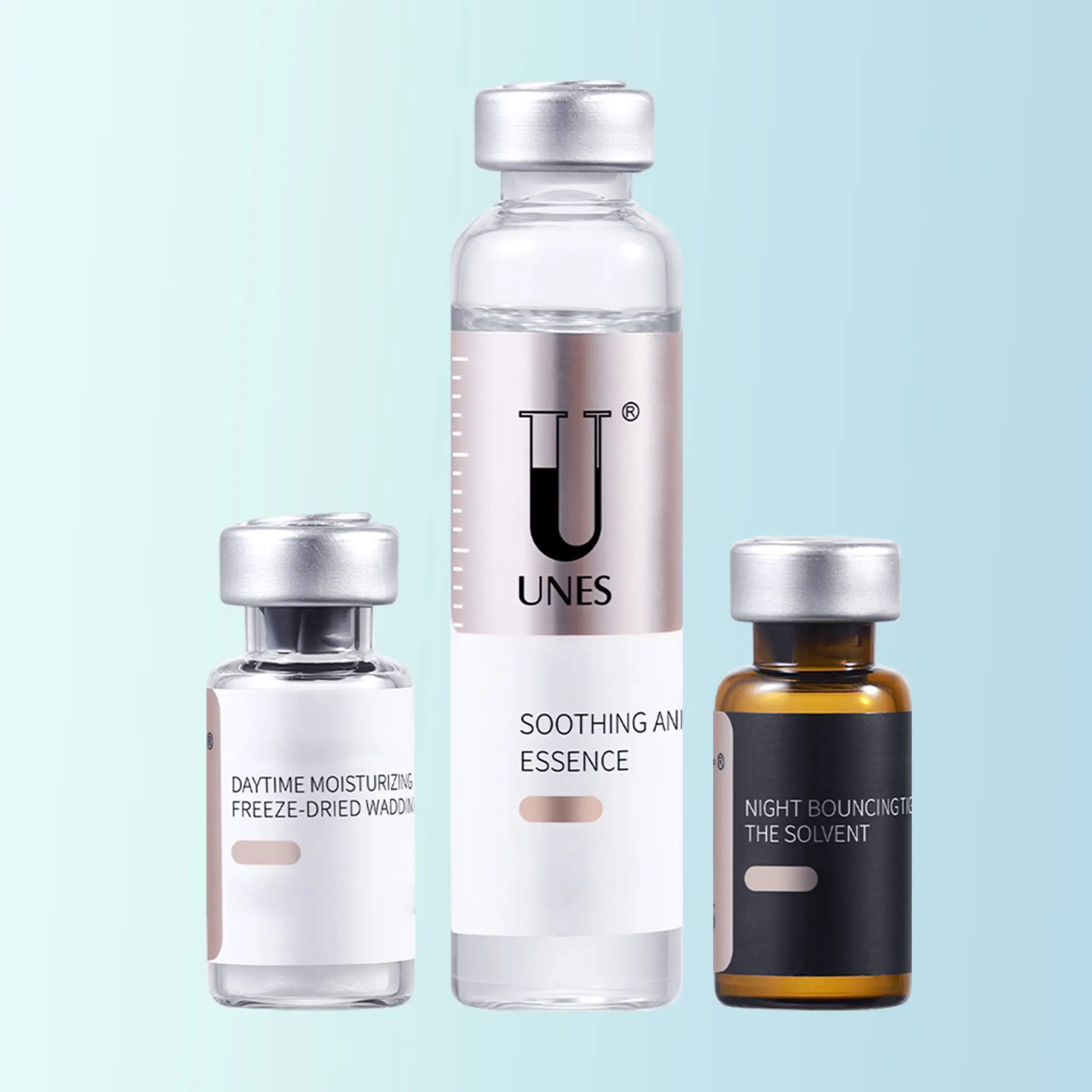
Dual-chamber and combination packaging sourcing. The dual-chamber format requires specialized packaging components — typically a vial or ampoule for the powder and a separate container for the activating liquid, with a mechanism to combine them at point of use. Sourcing these components requires established relationships with packaging suppliers and experience with compatibility testing between the formula and the packaging material.
SEYE's Private Label Freeze-Dried Skincare Platform addresses all of these requirements, with dedicated lyophilization equipment, GMP-certified clean room manufacturing, and an established portfolio of lyophilized formulas spanning vitamin C serums, peptide ampoules, brightening essence, and post-procedure recovery products. The platform supports MOQ from 500 units, with sample dispatch within 5–7 days of formula selection.
Building a Product Line Around Freeze-Dried Essence
The most successful private label brands in the freeze-dried skincare category do not launch a single product — they build a system. A particularly effective architecture combines three formats: the freeze-dried essence as the daily intensive treatment, a freeze-dried mask as the weekly deep-treatment step, and a lyophilised vitamin C serum or ampoule as the targeted brightening and antioxidant booster — all sharing the same lyophilised active complex at different concentrations and application frequencies. The freeze-dried essence functions most effectively as the hero product in a multi-step routine, supported by a preparatory toner or essence that primes the skin for absorption, and a finishing moisturizer or sunscreen that seals in the active payload.
This system approach has several commercial advantages. It increases the average order value per customer, creates natural cross-selling opportunities, and builds brand loyalty through routine adoption. Consumers who incorporate a freeze-dried essence into their daily routine are highly likely to repurchase — the visible efficacy of the format, combined with the ritual of reconstituting the powder, creates a product experience that is difficult to replicate with conventional serums.
For brands building a comprehensive skincare line, the Private Label Facial Serum platform provides a complementary liquid serum option that can be positioned as the daily maintenance product alongside the freeze-dried essence as the intensive treatment. This two-tier approach — daily serum plus intensive freeze-dried treatment — mirrors the structure used by premium Korean and Japanese skincare brands that have built strong repeat purchase rates in the category.
The R&D capabilities required to develop a competitive freeze-dried skincare line are significant, but the barrier to entry is lower than many brands assume when working with the right OEM partner. SEYE's R&D capabilities include a dedicated formulation team with experience in lyophilization process optimization, active ingredient compatibility testing, and stability protocol development — meaning brands can access pharmaceutical-grade manufacturing expertise without building it in-house.
Positioning and Pricing Strategy
Freeze-dried essence commands a premium over conventional serums, and the pricing strategy should reflect this. In the European and North American market, retail prices for freeze-dried essence products typically range from $45 to $150 per unit (depending on active ingredient complexity and packaging format), compared to $25–$80 for conventional serums in the same category. The price premium is justified by the demonstrable efficacy advantages of the format and the higher manufacturing cost — but it must be communicated clearly in the product's marketing materials.
The most effective positioning strategies for freeze-dried essence focus on three elements: the science of preservation (explaining why lyophilization delivers higher active potency), the ritual of reconstitution (making the powder-to-serum transformation a visible, tactile part of the product experience), and the clinical validation (providing efficacy data that substantiates the brand's claims). Brands that invest in clinical testing and consumer perception studies for their freeze-dried products consistently achieve higher conversion rates and lower return rates than those that rely on ingredient-only positioning.
Frequently Asked Questions
What is the minimum order quantity for private label freeze-dried essence? SEYE's minimum order quantity for freeze-dried skincare products starts from 500 units per SKU. Sample orders can be dispatched within 5–7 days of formula confirmation.
How long does a freeze-dried skincare product remain stable? Properly formulated and packaged freeze-dried skincare products typically have a shelf life of 24–36 months at room temperature, compared to 12–18 months for conventional liquid serums. Specific stability data is available for each formula upon request.
What packaging formats are available for freeze-dried essence? SEYE supports multiple packaging formats including single-dose ampoules, dual-chamber vials (powder + liquid), powder sachets, and lyophilized tablet formats. Custom packaging design and sourcing is included in the standard OEM service package.
Can the formula be customized for specific skin concerns or markets? Yes. SEYE offers full formula customization including active ingredient selection, concentration adjustment, fragrance profile, and activating liquid composition. Regional variants (e.g., brightening-focused for Middle East, anti-aging-focused for Europe) can be developed within the standard development timeline.
What certifications does the manufacturing facility hold? SEYE's manufacturing facility is GMP certified and ISO 22716 compliant. The facility operates dedicated clean room environments for lyophilization and sterile filling. Full export documentation including COA, MSDS, and stability test reports is provided for all orders.
How long does product development take? Standard development timeline from brief to production-ready formula is 25–35 days for existing formula adaptations, and 35–50 days for fully custom formulations. Sampling is available within 5–7 days of formula selection from the existing portfolio.
SEYE R&D Team
Formulation & OEM Strategy
Publication details are shown from the article record. Individual expertise, reviewer information, and review dates appear only when verified for public display.