The scalp microbiome is reshaping hair care. Discover why prebiotic and postbiotic scalp serums are becoming the most-requested OEM category, and how to formulate for three distinct global markets.
Scalp Microbiome Care: The Next Frontier in Private Label Hair Care
For years, the hair care industry focused almost entirely on the hair shaft — shine, strength, frizz control, and colour protection. The scalp was treated as a surface to be cleansed, not an ecosystem to be supported. That understanding is changing rapidly, and the shift is creating one of the most compelling private label opportunities in the beauty industry today.
The scalp microbiome — the community of bacteria, fungi, and other microorganisms that live on the scalp's surface — plays a central role in scalp health, hair follicle function, and the visible condition of hair. When that ecosystem falls out of balance, the consequences range from dryness and sensitivity to dandruff, inflammation, and accelerated hair thinning. When it is supported, the scalp maintains a healthy environment for stronger, healthier-looking hair.
This is why brands across Europe, the USA, the Middle East, and Southeast Asia are now actively seeking scalp microbiome serum formulations — and why SEYE has developed a dedicated Scalp Microbiome Serum Collection built specifically for global OEM and private label partners.
Why the Scalp Microbiome Matters to Consumers
According to a GlobalData 2025 Q4 global consumer survey of 22,613 respondents across 42 countries, 59% of consumers stated that their health and beauty product purchases are either always or often influenced by how well the product is tailored to their individual needs. This personalisation demand is directly driving interest in scalp microbiome care — consumers are no longer satisfied with generic shampoos and conditioners. They want targeted, science-backed solutions that address the root cause of their scalp concerns.
Naveed Khan, Consumer Analyst at GlobalData, summarised the trend clearly in February 2026: "Consumers are focusing on the scalp microbiome, as imbalances in the scalp environment have been linked to hair loss, inflammation, and other disorders. Rising demand for scalp-safe haircare products will create ample opportunities for innovations and will mark a new frontier in hair wellness."
The market data reflects this momentum. The global hair and scalp care market was valued at $88.2 billion in 2025 and is projected to reach $150.5 billion by 2033, growing at a CAGR of 7.0% (Grand View Research, June 2026). Within this broader market, microbiome-focused scalp care is growing faster than the category average, driven by the same "skinification" trend that transformed facial skincare over the past decade.
The Skinification of Hair Care
Skinification — the application of skincare science, ingredients, and rituals to hair care — is the most significant structural shift in the hair category in a generation. Consumers who have learned to look for niacinamide, hyaluronic acid, peptides, and ceramides in their facial serums are now asking for the same ingredients in their scalp treatments.
This creates a natural bridge between skincare and hair care for private label brands. A brand that already sells a microbiome-focused facial serum, for example, has a ready-made audience for a scalp microbiome serum — the same consumer values, the same ingredient literacy, and the same willingness to invest in premium, targeted formulations.
Major brands have already validated this direction. LG H&H launched the Microbiome BioExosome line under its Dr.Groot brand in South Korea in April 2025, targeting scalp environment management and hair loss root causes. Unilever introduced the Dove Derma Care range in Mexico with glycerine and niacinamide specifically positioned for scalp microbiome support. These launches signal that the category is moving from niche to mainstream — and that the window for private label brands to establish early positioning is open now.
Key Ingredients for Scalp Microbiome Formulation
Formulating for the scalp microbiome requires a different ingredient philosophy from traditional hair care. The goal is not to strip or sanitise the scalp, but to create conditions in which beneficial microorganisms can thrive. The most effective formulations combine several active systems.
| Ingredient | Function | Market Fit |
|---|---|---|
| Prebiotic Complex (Alpha-Glucan Oligosaccharide) | Selectively feeds beneficial scalp bacteria | Europe & USA, all markets |
| Postbiotic Ferment | Supports healthy scalp ecology through fermentation by-products | Europe & USA, premium positioning |
| Niacinamide | Scalp comfort, clarity, and barrier support | All markets |
| Caffeine | Energising scalp feel, circulation support | Europe & USA |
| Zinc PCA | Helps maintain comfortable scalp feel, reduces excess sebum | Southeast Asia |
| Tea Tree Leaf Water | Refreshing, antimicrobial sensory signature | Southeast Asia |
| Argan Oil | Luxurious scalp nourishment, dry climate care | Middle East |
| Biotin | Supports healthier-looking hair | All markets |
| Panthenol | Soothing, conditioning | Sensitive scalp formulas |
| Allantoin | Calming daily comfort | Europe & USA |
The most sophisticated scalp microbiome serums combine prebiotics (which feed beneficial bacteria), postbiotics (fermentation by-products that support the scalp environment), and targeted actives that address the specific climate and consumer expectations of each target market.
Three Markets, Three Formula Strategies
One of the most important insights from SEYE's product development work is that scalp care consumers in different regions have meaningfully different needs, expectations, and sensory preferences. A single global formula rarely performs optimally across all markets. This is why SEYE's Scalp Microbiome Serum Collection is built around three distinct regional concepts.
Europe & USA: Scalp Barrier Balance
Consumers in Europe and the USA are driving the clean beauty and derm-inspired scalp care movement. They are looking for transparent ingredient lists, sensitive-scalp-friendly formulations, and clinical positioning. The Scalp Barrier Balance Serum combines Prebiotic Complex, Niacinamide, Caffeine, Panthenol, Postbiotic Ferment, Allantoin, Rosemary Leaf Extract, and Peptide Complex in a clear, lightweight serum texture. The positioning is straightforward: support the scalp's natural microbiome balance, reduce sensitivity, and create a healthier environment for hair growth.
This formula aligns with the same values that have made microbiome-focused skincare one of the fastest-growing categories in facial care — and the same consumers who buy prebiotic face serums are the most likely early adopters for scalp microbiome treatments.
Middle East: Luxury Scalp Nourish
The Middle Eastern market demands a different approach. Consumers in this region expect a premium, indulgent sensory experience — rich textures, signature fragrances, and visible nourishment. Dry, arid climates create specific scalp challenges: dehydration, sensitivity from heat exposure, and a need for deep conditioning that lightweight Western serums cannot deliver.
The Luxury Scalp Nourish Serum addresses these needs with Argan Oil, Oud Extract, Biotin, Keratin Peptide, Camellia Oil, Hyaluronic Acid, Vitamin E, and Rose Water. The result is an amber botanical serum that delivers both visible luxury and genuine scalp nourishment — a product that fits naturally into the premium hair ritual culture of the Gulf region.
Southeast Asia: Aqua Fresh Scalp
Southeast Asian consumers face the opposite challenge: humid climates, oily scalp conditions, and a preference for ultra-lightweight, fast-absorbing formulas that do not weigh hair down. The Aqua Fresh Scalp Serum is built around Tea Tree Leaf Water, Mint Extract, Zinc PCA, a low-level salicylic system, Green Tea Extract, Bamboo Water, Fermented Rice Extract, and Biotin. The cooling, refreshing sensory experience is central to the product's appeal — and the fast-absorbing, oil-free texture ensures it fits seamlessly into the daily routines of consumers in tropical climates.
Available Textures and Packaging Options
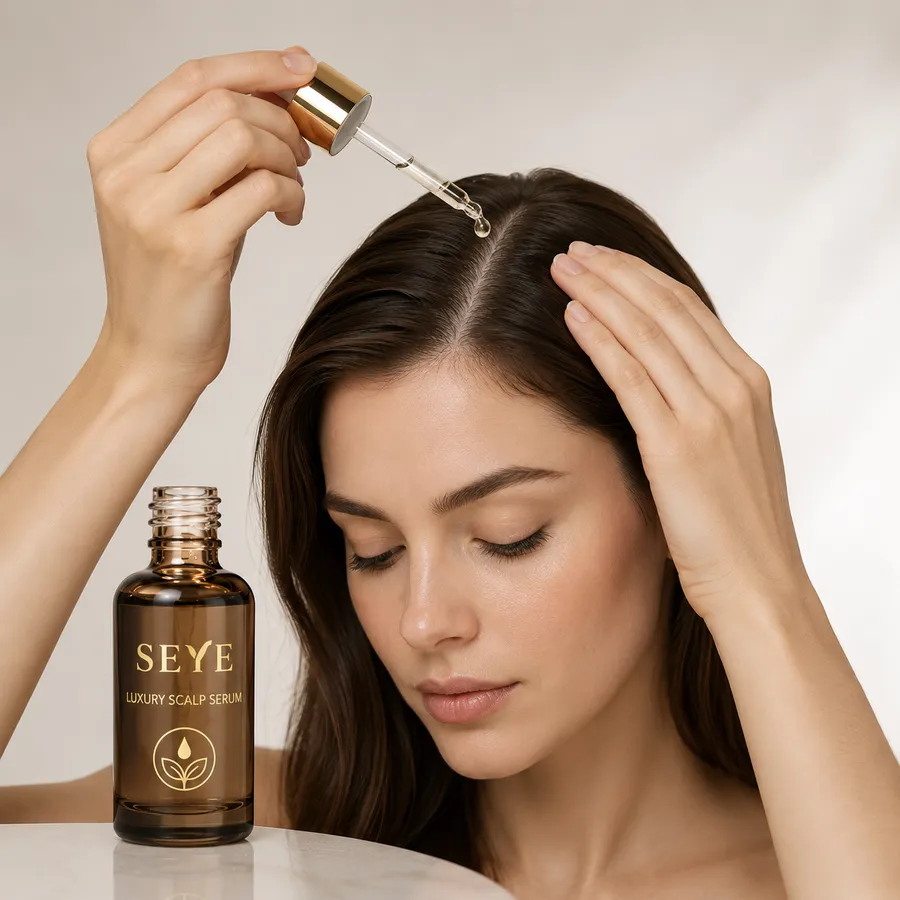
Scalp serums require packaging that enables precise, direct application to the scalp — not just the hair. SEYE's Scalp Microbiome Serum Collection is available in six texture formats: Clear Scalp Serum, Amber Botanical Serum, Milky Scalp Essence, Cooling Scalp Treatment, Oil-Free Serum, and Dual-Phase Scalp Elixir. Packaging options include glass dropper bottles, airless serum bottles, scalp applicators, and spray bottles, with custom fragrance and packaging support available for all formats.
This flexibility allows private label brands to differentiate not just through formula, but through the entire product experience — from the moment the consumer picks up the bottle to the sensory finish of the application ritual.
Why This Category Is a Strategic Opportunity for Private Label Brands
Scalp microbiome care sits at the intersection of several powerful consumer trends: the skinification of hair care, the growing demand for microbiome-friendly beauty, the premiumisation of scalp treatments, and the shift toward targeted, science-backed formulations. Each of these trends is independently strong — together, they create a category with exceptional growth potential and relatively low competitive saturation in the private label space.
For brands already operating in skincare, scalp microbiome serums offer a natural adjacent category expansion. For hair care brands looking to move upmarket, they offer a credible premium positioning anchor. And for new brands entering the beauty market, they offer a differentiated entry point in a category where consumer education is still in its early stages — meaning early movers have a genuine advantage.
The same principles that apply to successful skincare OEM development apply here: focus on a clear consumer need, choose actives that deliver on the promise, and partner with a manufacturer who can support both the formulation and the regulatory requirements of your target markets. SEYE's GMP / ISO 22716 certified facility, in-house R&D team of 30+ scientists, and 48-hour sample dispatch make it straightforward to move from concept to sample quickly — which matters in a category where speed to market is a real competitive advantage.
OEM Development Considerations
When developing a private label scalp microbiome serum, several factors deserve careful attention.
Regulatory positioning varies significantly by market. In Europe, prebiotic and postbiotic claims must be supported by appropriate documentation and must not cross into medicinal territory. In the USA, scalp health claims are generally permissible as cosmetic claims, but hair growth or hair loss prevention claims trigger drug classification. In Southeast Asia, regulatory frameworks vary by country, and local compliance support is essential. SEYE provides full export documentation including COA, MSDS, and regulatory support for EU CPNP and FDA registration.
Texture selection should be driven by target market and consumer routine, not just formula preference. A cooling water essence that performs brilliantly in Singapore may feel underwhelming to a consumer in Riyadh expecting a rich, indulgent treatment. Regional consumer testing or market research should inform texture decisions before finalising the formula.
Packaging and application experience matter more in scalp care than in most other categories, because the application method — parting hair, applying directly to the scalp, massaging — is inherently more involved than applying a face serum. Packaging that makes this ritual easy and precise will drive repeat purchase; packaging that makes it messy or imprecise will create a negative experience regardless of formula quality.
MOQ and sampling strategy should be planned from the start. SEYE supports MOQ from 500 units per formula, with 48-hour sample dispatch — which means brands can validate consumer response with a small initial run before committing to larger production volumes. This is particularly valuable in a new category where consumer education is still ongoing. You can explore the full Scalp Microbiome Serum Collection or contact SEYE to request a sample.
Frequently Asked Questions
What is a scalp microbiome serum? A scalp microbiome serum is a leave-in treatment applied directly to the scalp, formulated with prebiotics, postbiotics, and targeted actives designed to support a balanced scalp microbiome environment. Unlike shampoos, which are rinsed off, scalp serums remain on the scalp to deliver sustained active benefits.
How is a scalp microbiome serum different from a regular scalp tonic? Traditional scalp tonics typically focus on stimulation or oil control. Scalp microbiome serums are formulated with a more sophisticated active system — prebiotics to feed beneficial bacteria, postbiotics to support the scalp ecology, and targeted ingredients that address specific climate and consumer needs. The positioning is closer to a skincare serum than a traditional hair product.
What MOQ does SEYE support for scalp microbiome serums? SEYE supports MOQ from 500 units per formula, with 48-hour sample dispatch. Each of the three regional formulas — Scalp Barrier Balance, Luxury Scalp Nourish, and Aqua Fresh Scalp — can be commissioned independently or combined into a complete scalp care line.
Can the formulas be customised for my brand? Yes. Each formula is independently customisable in texture, actives, fragrance, and packaging. SEYE's in-house R&D team of 30+ scientists can also develop fully custom scalp care formulas from brief.
What certifications does SEYE hold for hair care manufacturing? SEYE's manufacturing facility is GMP / ISO 22716 certified, with FDA registration and EU CPNP support available. Full export documentation including COA and MSDS is provided upon request.
SEYE Cosmetics
Product Development Team, SEYE Cosmetics
Publication details are shown from the article record. Individual expertise, reviewer information, and review dates appear only when verified for public display.