
Packaging MOQ can exceed the quantity you plan to fill. Compare stock and custom routes, component minimums, decoration and unused-packaging commitments before approving a small skincare OEM order.
Illustrative examples: The quantities and unit prices in this guide explain procurement trade-offs. They are not SEYE quotations, guaranteed supplier minimums or universal order conditions.
A skincare manufacturer tells you "we can produce 500 units." Great. Then you choose a bottle and ask for your custom color, and the answer changes: "this packaging requires 3,000 units." Now the project becomes confusing — if the factory can manufacture 500 finished products, why can't it simply order 500 bottles?
Short Answer: Because there are often two completely different minimum order quantities inside one skincare project — Formula or Finished-Product MOQ and Packaging MOQ — created by different suppliers, machinery and production economics. The finished-product MOQ is not automatically the packaging MOQ, and when several packaging components are involved, the packaging purchase commitment is often driven by the component with the highest minimum requirement. That does not automatically mean the same number of filled products must be produced.
Key Takeaways
- Stock packaging MOQ is based on inventory availability ; custom packaging MOQ is based on production economics — a fundamentally different logic.
- Custom color, decoration and even a specific pump component can each carry a separate MOQ from the bottle body.
- The MOQ of a complete package is often set by its least flexible component — not the most visible one.
- A higher packaging MOQ doesn't always mean producing that many finished products — excess packaging may be reserved for future reorders if storage and reuse terms are agreed, but it is still a financial commitment.
- MOQ and price break are different concepts: MOQ is the minimum the supplier will produce; price break is the quantity where unit price improves.
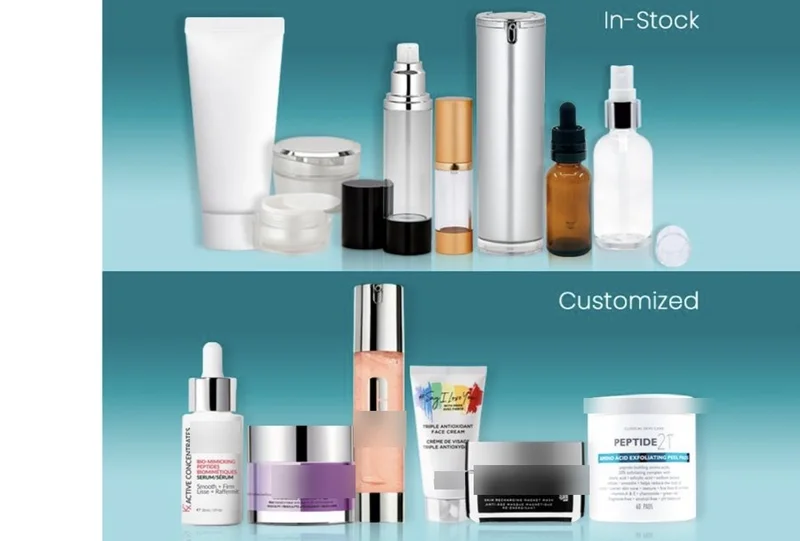
Stock packaging can be supplied from existing inventory, while selected custom components or decoration steps may require their own production runs.
Formula and Packaging Are Different Supply Chains
A private label product may look like one product to the consumer, but before production it involves several supply chains: the formula manufacturer, the primary packaging supplier, the decoration supplier, and the secondary packaging supplier. The skincare manufacturer coordinates these pieces but doesn't control every supplier's production economics — which is why an illustrative project might combine a 500-unit filling run, a 1,000-unit bottle minimum and a 3,000-unit custom-color requirement. Formula manufacturing can also have a separate minimum batch size, so confirm formula batch, filled-unit and component quantities independently. Our low-MOQ private-label skincare hub explains the project-specific starting conditions.
Where the Extra Packaging MOQ Comes From
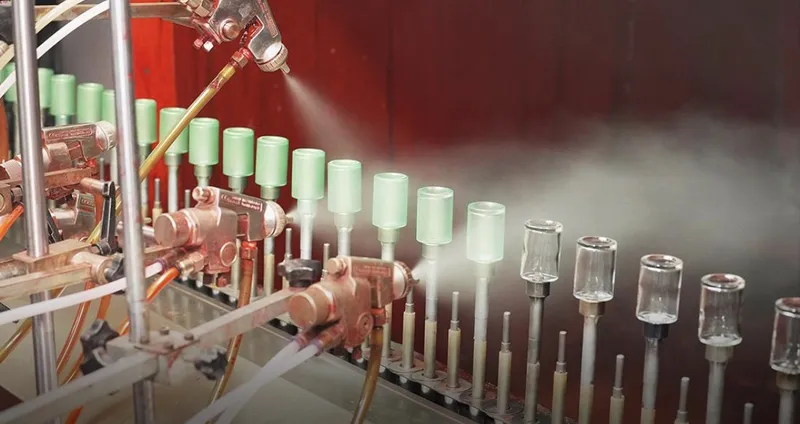
Custom glass coating may require coating-material preparation, color matching, equipment setup and curing. Coloring molded plastic instead may use a pigment masterbatch; the processes are not interchangeable.
Different Machinery
Injection molding, blow molding and component assembly each require machine setup — time, labor and material that make very small runs economically inefficient for the supplier.
Stock vs Custom Logic
Stock packaging ships from existing inventory, so small quantities are often available. Custom packaging requires a dedicated production run — that run creates the MOQ.
Custom Color on a Stock Bottle
For example, a white stock bottle may be offered in a smaller quantity, while a custom green version requires a separate color run. For molded plastic this may involve pigment masterbatch preparation; for glass it may involve a coating process. The mold can remain standard while the color requirement changes the purchase minimum.
Decoration's Own MOQ
Screen preparation, ink setup and color adjustment for printing, or dedicated color prep and curing for coating, can each carry a separate minimum from the bare bottle.
Multi-Component Systems
An airless package (outer bottle, inner container, piston, pump, actuator, collar, cap) may not all come from the same production run — the complete package purchase minimum may be driven by the least flexible part, such as a custom actuator color. Confirm the supplier quote for the assembled system rather than assuming each component minimum translates directly into a finished-product quantity.
Custom Molds
A proprietary bottle shape adds tooling cost on top of production setup cost — a very small commercial order may not economically justify the process at all.
Comparison: MOQ vs Price Break
| Concept | Definition | Example |
|---|---|---|
| MOQ | The minimum quantity the supplier is willing or able to produce | 1,000 pcs minimum |
| Price Break | A quantity where the unit price improves | 1,000 pcs = $0.82; 3,000 pcs = $0.68; 5,000 pcs = $0.59 |
In the illustrative price ladder above, the supplier accepts 1,000 pieces and offers lower unit prices at higher quantities. Actual quotes can also reflect material, decoration, freight and commercial terms. Understanding the difference helps brands negotiate more intelligently: negotiating MOQ and negotiating unit price are not always the same conversation. Compare setup charges and quantity terms with the low-MOQ hidden-cost and lead-time checklist.
Recommendations: Six Ways to Reduce Packaging MOQ Pressure
- 1. Start with an existing structure — stock bottle, jar, pump or tube, then differentiate through design.
- 2. Customize the most visible elements only — a stock bottle with suitable printing and a coordinated carton may provide enough differentiation without customizing every component. Compare the cash commitment in our formula-versus-packaging budget guide.
- 3. Use standard colors where possible to avoid a dedicated color production run.
- 4. Use labels strategically — they often offer more small-batch flexibility than direct printing or custom coating.
- 5. Delay the proprietary mold — move from Stock → Semi-Custom → Fully Custom as demand becomes clearer.
- 6. Ask for multiple packaging routes (lowest commitment / balanced / high differentiation) so you can compare MOQ, cost, visual impact and cash commitment together.
Key question: instead of "is 3,000 packaging MOQ too high?", ask "how confident are we that we will consume these 3,000 packages?" The number itself is not the whole problem — the problem is the relationship between MOQ and demand certainty. Review your first-order SKU count before multiplying component commitments across variants.
OEM Development: A Six-Layer Packaging MOQ Stack
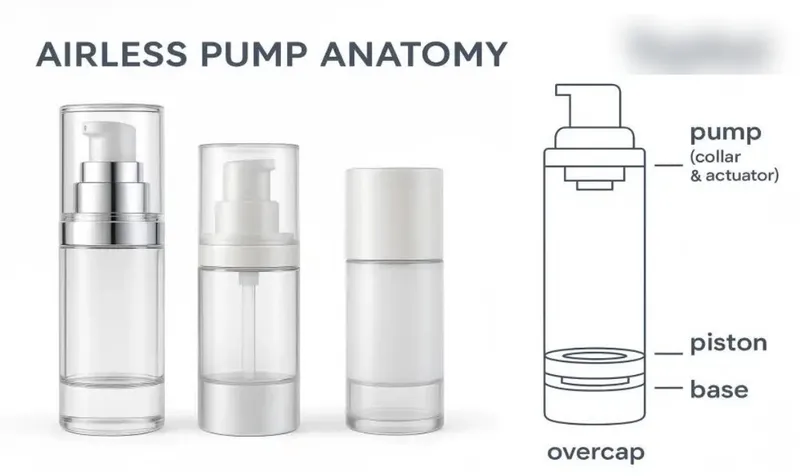
An airless system has several components. Separate supplier minimums may constrain the selected package or its procurement plan; confirm the quantities for the assembled system.
Map every layer before approving packaging: Layer 1 — base container (stock, made-to-order, or custom mold?); Layer 2 — components (pump, cap, dropper, actuator, liner); Layer 3 — color (existing, standard or fully custom?); Layer 4 — decoration (printing, coating, foil, metallization?); Layer 5 — secondary packaging (carton, insert, tray, gift box); Layer 6 — finished-product production quantity. Also confirm in writing: whether unused packaging may be retained, its owner and location, storage charges and conditions, the agreed holding period, stock reconciliation, inspection before reuse, and who bears the risk of damage or obsolete artwork. Align this with the first-order reorder-readiness guide. For related planning, see our guide on private label skincare MOQ .
Frequently Asked Questions
Why can a skincare factory produce 500 units but packaging requires 3,000?
The 500- and 3,000-unit figures are illustrative, not SEYE commitments. Formula manufacturing, filling and packaging use different production steps and setup economics. A selected packaging route may require a larger purchase than the planned filling run; confirm both quantities and their payment terms project by project.
Does a lower finished-product MOQ guarantee low packaging MOQ too?
No. A low finished-product MOQ does not automatically mean every customized packaging component shares the same MOQ — always confirm the MOQ of the complete decorated package.
Can I buy more packaging than I need and use the rest later?
Sometimes, if the supplier or manufacturer agrees to an inventory arrangement. Confirm ownership, storage conditions and charges, holding period, stock reconciliation and inspection before reuse in writing. Unused packaging remains a financial commitment, and changes to artwork, size or branding can make it unsuitable for later orders.
Does custom color always increase MOQ on a stock bottle?
Often, yes, when the requested color requires a separate production or coating run. A standard color already held in inventory may not need that additional run. Confirm the quoted minimum for the specific bottle material, color method and supplier.
How can I negotiate a lower packaging MOQ?
Understand whether the constraint is pricing or a genuine manufacturing minimum, and consider reducing customization (color, decoration, mold) rather than asking the supplier to shrink an industrial production run.
Final Takeaway
The phrase "our MOQ is 500" should never automatically be interpreted as "every possible customized component can also be produced in 500 pieces." Formula MOQ and packaging MOQ are separate commitments shaped by separate supply chains — understanding the six-layer stack (structure, components, color, decoration, secondary packaging, production quantity) turns a confusing single number into a transparent project structure.
Planning Packaging for a Small First Order?
Send SEYE your product category, target quantity, packaging style, decoration preference and target market . Our team can review likely component constraints and confirm them project-specifically before you commit to a packaging route.
Discuss your packaging MOQ with SEYE. Starting MOQ is subject to formula, packaging and market documentation; request a project-specific quotation. Packaging confirmation is project-specific after component sourcing, pack-compatibility review and artwork sign-off. Production scheduling depends on project readiness, not the lowest quantity mentioned in an initial discussion. Use our sample-to-first-order responsibility matrix to assign approval owners and open component decisions.
SEYE Cosmetics
OEM Packaging & Project Planning
Publication details are shown from the article record. Individual expertise, reviewer information, and review dates appear only when verified for public display.