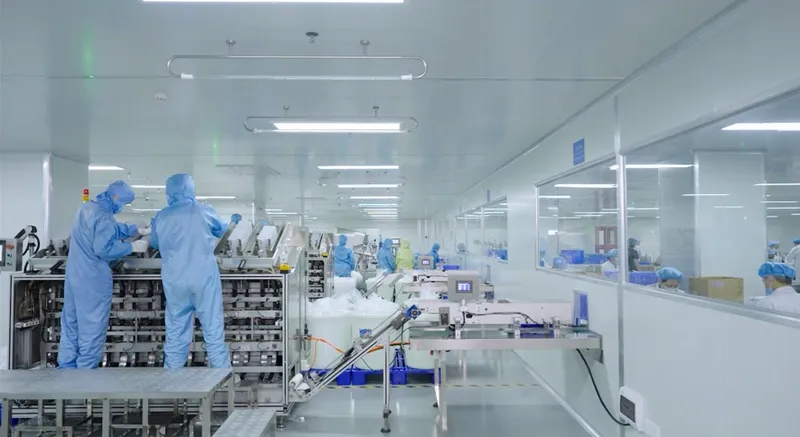
Before approving a skincare formula for bulk production, align the formula revision, sensory standard, specifications, packaging, claims, market files, artwork and reference sample. Use this eight-area checklist to document decisions and open responsibilities.
You receive the latest sample from your OEM manufacturer. Texture feels right, absorption is good, fragrance is acceptable. You message the supplier: "approved, please proceed with bulk production." That sounds like the end of development — in reality, it should be the beginning of a much more precise approval step.
Short Answer: There is an important difference between "I like this sample" and "this is the exact commercial product I approve for manufacturing." Before bulk production, confirm eight areas: Formula Identity → Sensory Standard → Product Specification → Packaging Compatibility → Claims → Documentation → Artwork → Production Reference. The goal is to make sure everyone means the same thing when they say "approved."
Key Takeaways
- Record the exact approved formula version and revision — "the last sample" or "the one I liked" is not identifiable weeks later.
- Approve the sensory standard explicitly (spreadability, absorption, tack, finish), not just the ingredient list.
- "Same as sample" should mean conformity to an agreed specification, not zero measurable variation — production scale changes manufacturing conditions.
- Confirm claims before printing — an ingredient's presence does not itself substantiate a marketing statement.
- Finalize artwork only after formula and regulatory information are stable — one late ingredient change can force a reprint.
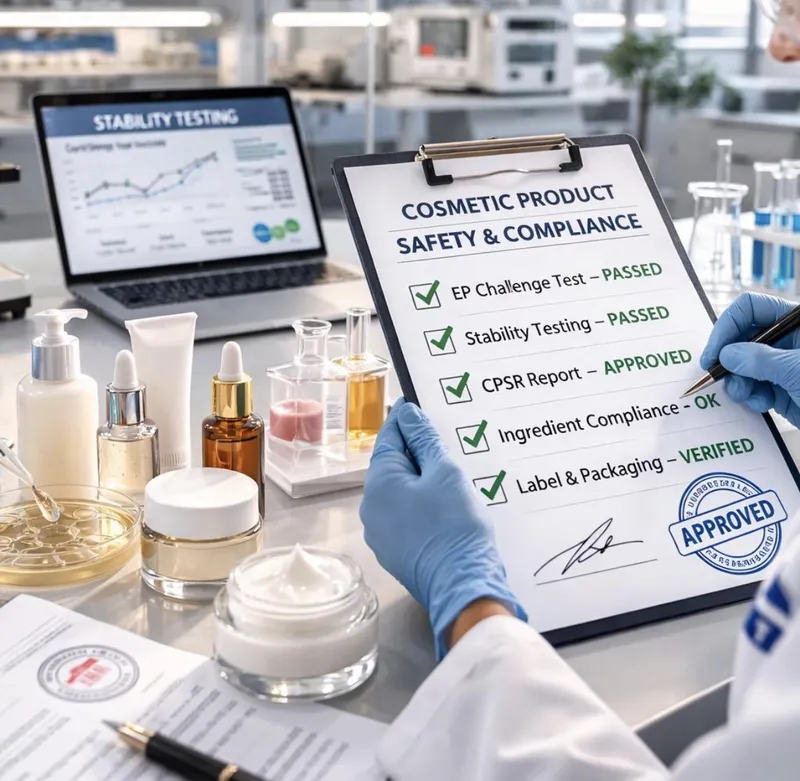
Illustrative workflow image only; it is not evidence of testing, stability results, or CPSR approval for any specific product.
For an earlier-stage sensory review, start with our OEM skincare sample-evaluation guide. Liking a sample and releasing a defined manufacturing version are separate decisions.
Why This Matters: Sample Approval Should Become a Manufacturing Standard
During sampling you may receive Sample A, B, B-2, a revised sample and a "final" sample. After several rounds of messages and courier shipments, it's easy for brand and R&D to refer to different versions. Record the exact reference — for example "Formula Code BR-2406-03, Approved Sample Revision 3, Approval Date [date]." Bulk production should be linked to an identifiable approved formula version, not a vague phrase. For revised or custom projects, use the custom-formula development process to record accepted changes and the version being released.
Market Insights: What "Approved" Actually Needs to Cover
Formula Identity & Changes
Confirm the final INCI direction and that all accepted feedback (less sticky, less fragrance, added active) is actually reflected in the approved sample — not scattered across chat history.
Sensory Standard
Define spreadability, absorption speed, tackiness, richness, finish and layering behavior explicitly — "texture OK" is not a commercial target a manufacturer can reproduce.
Fragrance, Color, Appearance
Confirm fragranced or fragrance-free, target shade and the agreed acceptable tolerance — especially for formulas with botanical extracts that naturally contribute color.
Product Specification
pH, viscosity, appearance, microbiological criteria and other measurable parameters give production and QC boundaries a reference sample alone cannot define.
Packaging Compatibility
Confirm dispensing, closure seal, leakage risk and consumer accessibility with the actual packaging — not the lab sample jar.
Fill Size & Method
"30 mL bottle" and "30 mL declared content" are not always the same — confirm declared net content, target fill and filling tolerance before production.
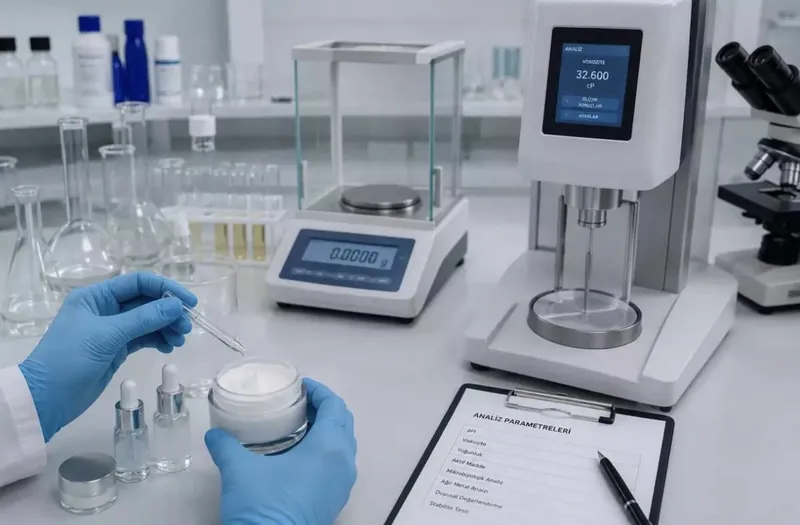
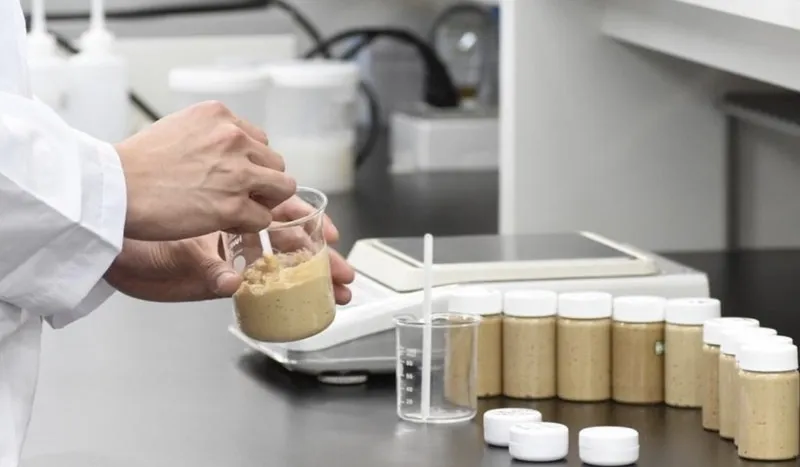
Illustrative laboratory scene. Agree test methods, conditions and acceptance limits for pH, viscosity and microbiological criteria; the pictured readings are not project specifications.
Comparison: What "Same as Sample" Should Actually Mean
| Unrealistic Expectation | Realistic Manufacturing Standard |
|---|---|
| "Bulk must be 100% identical to the laboratory sample" | "The commercial batch must conform to the approved formula and agreed specifications" |
| "Please make it exactly like the sample" | "Please manufacture according to the approved formula revision, reference sample and agreed specifications" |
| "Use the formula we discussed" | "Please use Formula Code XX, Revision 3, approved on [date]" |
| "Packaging is the same as before" | Confirm the actual packaging SKU or approved physical package |
Laboratory and industrial manufacturing operate at different scales — bulk production should be assessed against the approved formula and agreed specifications, with any permitted variation defined in advance.
Read our laboratory-sample versus bulk-production variation guide for how scale-up differences should be evaluated against agreed standards, not used to excuse nonconformity.
Recommendations: Separate "Must Match" From "Nice to Have"
- Must Match: formula version, key active direction, fragrance-free requirement, target texture, pH specification, packaging, net content.
- Preferred: minor shade or sensory differences only where they remain within the agreed specification and tolerance.
Key question: before bulk production, ask "what product version and packaging does the available stability information actually support?" — not simply "is it stable?" And confirm claims before printing: an ingredient's presence does not by itself substantiate quantitative, performance, safety or regulatory statements.
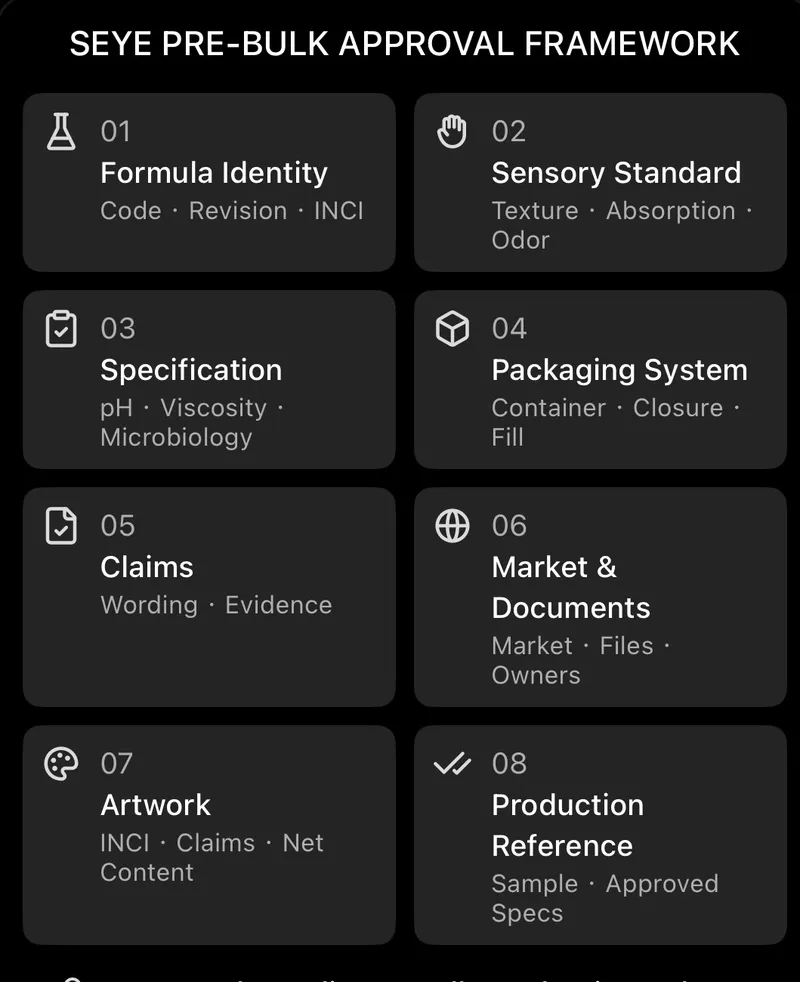
SEYE’s eight-point framework helps document the transition from a liked sample to a product intended for controlled commercial production.
Confirm component availability, decoration and purchasing commitments alongside the physical pack; our packaging MOQ versus formula MOQ guide explains why those commitments can differ.
OEM Development Considerations: The SEYE Pre-Bulk Approval Framework
Confirm all eight areas together: 1) Formula Identity (code, revision, final INCI); 2) Sensory Standard (texture, absorption, fragrance, color); 3) Technical Specification (pH, viscosity, microbiological criteria); 4) Packaging System (container, closure, compatibility, net content); 5) Claims (intended benefits, wording, substantiation); 6) Market & Documentation (target markets, required files, responsibilities); 7) Artwork (INCI, claims, net content, final version); 8) Production Reference (approved physical sample, written specifications). Also reconfirm the target market explicitly — "we also want to sell in Germany and the U.K." after a U.S.-only brief can affect label information, Responsible Person requirements and claims. Use our global cosmetics compliance hub to scope target-market files and responsibilities. Brand sample approval is not a safety assessment or authorization to place a product on the market. Record any open requirements and their owners before production release.
Before authorizing production, assign written approval owners using the sample-to-first-order responsibility matrix. Keep this pre-production decision separate from later batch release; our COA, batch-record and release-document guide explains the evidence used for the manufactured batch.
Frequently Asked Questions
Is sample approval enough to start bulk production?
Not by itself. The sample is an important reference, but formula version, specifications, packaging, net content, claims, documentation and artwork should also be confirmed.
Does bulk production need to be 100% identical to the lab sample?
The commercial batch should conform to the approved formula and agreed quality specifications — the correct standard is controlled conformity, not an unrealistic expectation of zero measurable variation.
Should packaging be finalized before bulk production?
Yes. The actual formula and final packaging system should be confirmed together before filling, particularly where viscosity, dispensing or compatibility matters.
Should I approve artwork before or after the formula?
Final artwork should generally follow stable formula and technical information so the ingredient list, claims and net content are correct.
What happens if I change the formula after approval?
A meaningful change should create a new revision and trigger review of any affected areas such as INCI, stability support, packaging compatibility, claims, documentation or artwork.
Final Takeaway
The most dangerous word in skincare manufacturing can be "approved" — not because approval is bad, but because two sides may believe they approved different things. A strong bulk-production approval connects Formula, Sensory Standard, Specification, Packaging, Claims, Documentation, Artwork and Reference Sample. The goal: document the product requirements and approvals needed before controlled commercial production.
Preparing to Approve a Skincare Formula for Bulk Production?
Send SEYE your approved sample, product requirements, packaging, target market and order quantity. Our team can help review the formula, packaging, specifications and project documentation before the product moves into commercial production; final approvals and market responsibilities should be confirmed for the applicable project.
Review your pre-bulk checklist with SEYE. Starting MOQ is subject to formula, packaging and market documentation; request a project-specific quotation. Production timing starts only after formula approval, packaging confirmation, artwork sign-off, required market documentation, component availability and agreed payment conditions are complete.
SEYE Cosmetics
OEM Development & Quality Planning
Publication details are shown from the article record. Individual expertise, reviewer information, and review dates appear only when verified for public display.